











Cloud Cost Optimization Strategies That Reduce Waste and Support Long-Term Scalability
09/04/2026
705
Cloud cost optimization strategies become important when cloud spending starts growing faster than the business value it supports. In the beginning, cloud infrastructure often feels efficient and flexible. Teams can launch faster, scale without large upfront investment, and avoid the burden of managing physical servers. But as products grow, systems become more complex, and usage expands across teams, cloud costs often rise in ways that are difficult to track and even harder to control.
That is why cloud optimization should not be treated as a simple cost-cutting exercise. The real goal is to make sure cloud resources are being used in a way that supports performance, delivery speed, and long-term scalability without creating avoidable waste. Businesses that approach optimization with this mindset are usually in a much stronger position to control costs while still building for growth.
Why Cloud Costs Become Harder to Control as a Business Grows
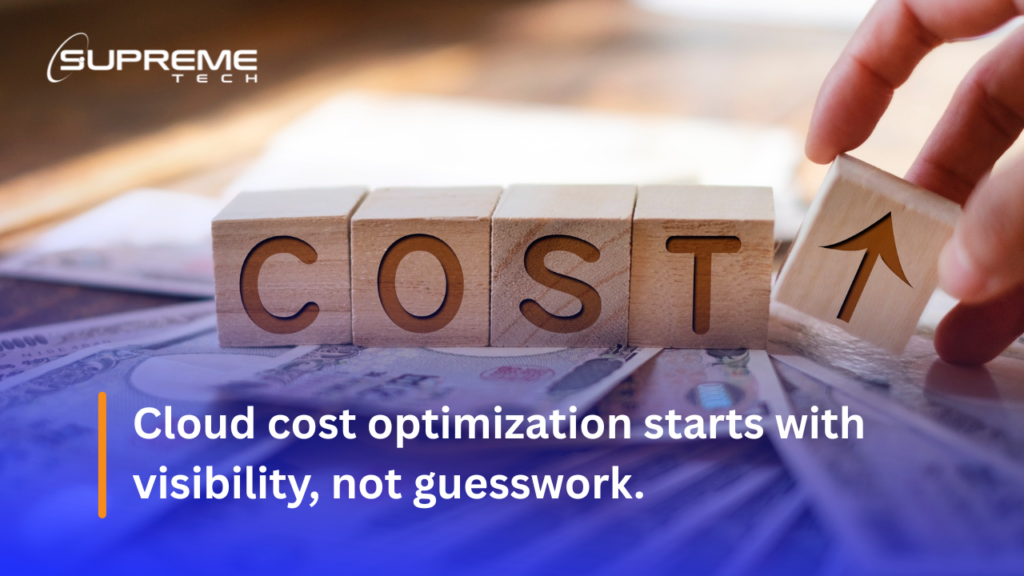
Cloud costs usually become harder to control for the same reason cloud adoption becomes more valuable: the business starts depending on it more heavily. In the early stage, infrastructure decisions are often made quickly to support product delivery, reduce technical risk, and help teams move faster. Those decisions are often reasonable at the time, especially when speed and stability matter more than fine-tuned efficiency.
The challenge appears as those decisions accumulate. A company may add more environments for development and testing. New features may require additional databases, storage layers, monitoring tools, integrations, and security services. Different teams may provision resources based on immediate needs, while older environments or temporary workloads remain active longer than expected. None of these choices may look serious on their own, but together they create a cloud environment that is more expensive and more difficult to manage.
This is why cloud cost problems in growing businesses rarely come from one major mistake. More often, they come from the gradual build-up of small, sensible decisions that were never reviewed as the business evolved. Over time, leadership sees the total spend increasing, finance sees less predictability, and engineering teams often lack a full picture of which parts of the environment are driving the most waste.
That is also why cloud cost optimization needs to be treated as an ongoing business discipline rather than a one-time clean-up effort. If the goal is long-term scalability, businesses need to regularly bring infrastructure usage, architecture decisions, and operating practices back into alignment with actual business needs.
7 Cloud Cost Optimization Strategies That Actually Work
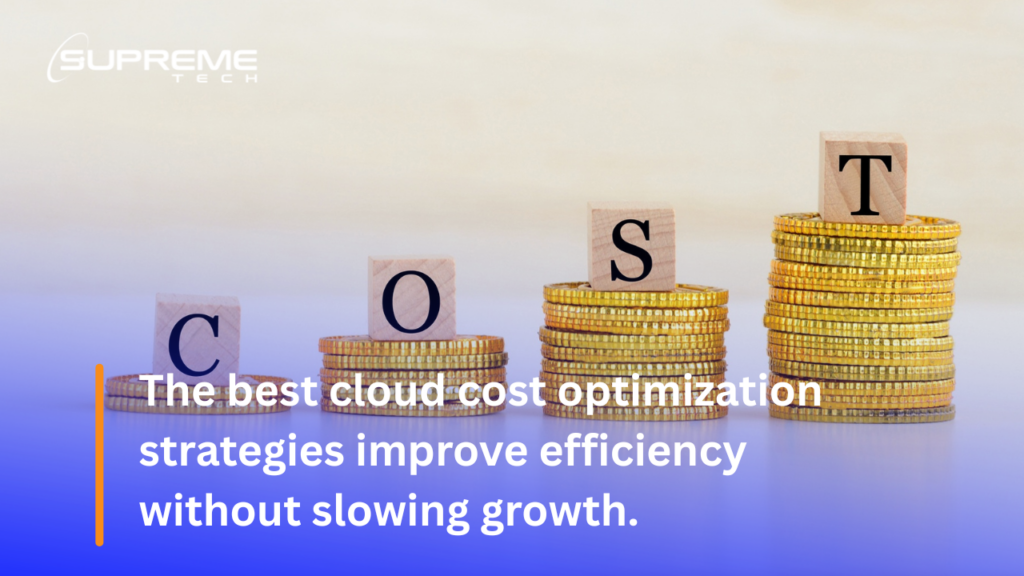
1. Build visibility before trying to reduce spend
Many cloud cost problems begin with limited visibility, not bad intent. Teams often know the total bill is rising, but they do not have a clear view of which products, environments, services, or usage patterns are driving it. That makes optimization reactive. It also makes it easier for waste to hide inside normal growth.
This is why the first step in most cloud cost optimization strategies should be cost transparency. Businesses need usable tagging, cost allocation by team or workload, and a regular way to review where spend is increasing and why. The FinOps Foundation explicitly frames usage optimization around examining top-spend categories first, while Google Cloud’s cost-optimization guidance also emphasizes tracking and allocating costs before acting on them.
A good real-world example is Sky. Google Cloud says Sky identified more than $1.5 million in savings after strengthening its Cloud FinOps discipline and reviewing cost behavior across services such as BigQuery, Compute Engine, and Cloud Storage. The lesson is not just that savings were possible. It is that meaningful savings became easier once cost visibility improved.
2. Right-size infrastructure based on actual workload behavior
Overprovisioning is one of the most common reasons cloud spend grows faster than expected. Teams often choose larger instances or more headroom than they currently need because they want to protect performance and avoid delivery risk. That can be reasonable at launch. The problem is when those decisions remain unchanged long after traffic patterns, workloads, or business priorities have evolved.
Rightsizing works because it replaces assumptions with actual usage data. FinOps Foundation guidance on rightsizing in Azure focuses on matching resources to workload requirements while reducing business risk, and Google Cloud’s Well-Architected guidance also recommends right-sizing based on real usage and demand rather than fixed assumptions
GE Vernova offers a useful example. AWS says the company cut about $1 million in costs while improving compute performance through infrastructure optimization and processor migration. The point here is important for this article: rightsizing is not only about reducing resource size. Done well, it can improve efficiency and performance at the same time.
3. Remove idle resources and control waste continuously
A surprising amount of cloud waste comes from resources that were useful once but are no longer supporting real business activity. These can include unattached storage volumes, unused snapshots, old test environments, underutilized databases, and temporary workloads that were never shut down properly.
This is not just anecdotal. The FinOps Foundation’s optimization guidance highlights shutting down unused resources and using infrastructure-as-code and lifecycle controls to reduce waste over time. AWS also says its Cost Optimization Hub consolidates recommendations for idle-resource detection, rightsizing, and other optimization actions across accounts and regions.
4. Use autoscaling, scheduling, and pricing models more deliberately
Not every workload needs the same cost model. Some environments need elasticity because demand changes during the day or across seasons. Others are predictable enough to benefit from commitment-based discounts. Some internal environments do not need to run around the clock at all.
Google Cloud recommends autoscaling and regular resource review as part of operational excellence, while AWS highlights Savings Plans, Reserved Instances, and Spot pricing as ways to reduce cost when they match workload patterns. AWS says customers can save up to 72% with Reserved Instances and Savings Plans and up to 90% with Spot Instances, though those figures depend heavily on workload suitability and usage profile
5. Review storage and data movement, not just compute
Many businesses focus first on compute because it is easy to see and easy to discuss. But storage, retention practices, and data transfer patterns often become major cost drivers as a platform grows. Backups may be duplicated, cold data may stay in expensive tiers, logs may accumulate well beyond operational value, and traffic between services or regions may create avoidable transfer costs.
Google Cloud’s best-practice guidance specifically calls out storage lifecycle management and other cost patterns that teams often miss, while its Well-Architected Framework ties cost optimization directly to aligning spending with measurable business value.
How Cloud Cost Optimization Supports Long-Term Scalability
The most useful cloud cost optimization strategies do more than lower waste in the current quarter. They help a business scale in a healthier way over time. That matters because long-term scalability is not only about handling more traffic, more data, or more users. It is also about making sure growth does not create a cost structure that becomes harder to sustain with each new release, market expansion, or product line.
This is where many businesses misread the role of optimization. They treat it as a finance exercise that begins only when spending feels too high. In reality, cloud cost discipline has a direct impact on how sustainably a company can grow. Google Cloud’s Well-Architected Framework explicitly connects cost optimization to strategic cost management across the cloud journey, and its architecture guidance frames cloud design around being secure, efficient, resilient, high-performing, cost-effective, and sustainable.
One reason this matters is that inefficient systems usually become more expensive faster than the business expects. A storage decision that looks manageable at one stage can become a major cost driver as data volume grows. An oversized infrastructure pattern may feel acceptable during launch, but become increasingly wasteful once multiplied across products, environments, or regions. When architecture, usage, and governance are not reviewed regularly, scale tends to amplify inefficiency rather than value.
That is why strong optimization supports scalability in several ways at once. First, it improves cost predictability. Leadership can plan growth more confidently when cloud spending is easier to understand and forecast. Second, it reduces structural waste, so more of the technology budget goes toward product improvement rather than avoidable overhead. Third, it strengthens operating discipline. Teams become better at aligning infrastructure decisions with real business priorities instead of relying on assumptions or inherited patterns.
This broader view is also reflected in current industry research. The State of FinOps 2025 says the survey reflects organizations responsible for more than $69 billion in cloud spend, while the FinOps Foundation’s 2025 framework update shows that optimization, governance, organizational alignment, and forecasting are increasingly connected as part of a mature cost-management practice. In parallel, Flexera’s 2025 State of the Cloud findings say 84% of organizations see managing cloud spend as their top cloud challenge. Together, these signals suggest that cloud efficiency is no longer a narrow technical concern. It is a scaling concern, an operating concern, and a leadership concern.
AWS makes a similar point in its Well-Architected guidance by describing cost optimization as a continual process of refinement over the span of a workload’s lifecycle. That idea is important for growing businesses. If cost optimization is treated as an ongoing capability, the business is in a better position to keep expanding without letting complexity and spend drift too far apart. If it is treated as a one-time clean-up exercise, the same inefficiencies usually return as the environment evolves.
In practical terms, long-term scalability depends on whether the cloud environment can grow without becoming financially fragile. A scalable cloud model is one where usage patterns are visible, architecture choices are reviewed as the business changes, and governance is strong enough to support growth without slowing teams down unnecessarily. When those pieces are in place, cloud optimization stops being just a cost-control topic. It becomes part of how the business builds for resilience, flexibility, and sustainable growth.
Conclusion
Cloud cost optimization strategies are often discussed as a way to reduce short-term spending, but their real value is much broader than that. When approached strategically, they help businesses create a cloud environment that is easier to manage, more predictable to scale, and better aligned with long-term business goals.
That is what makes cloud optimization important for growing companies. As products become more complex and infrastructure expands across teams, regions, and environments, small inefficiencies can quickly turn into structural cost problems. The businesses that handle this well are usually not the ones making the most aggressive cuts. They are the ones building better visibility, stronger cost discipline, and more thoughtful architectural decision-making over time.
This is also why cloud optimization should not be treated as a one-time clean-up project. It works best as an ongoing operating practice that connects engineering, finance, and leadership around a shared goal: supporting growth without letting complexity and waste scale at the same pace.For businesses focused on cloud optimization, cost control, and long-term scalability, the real opportunity is not just to spend less on cloud. It is to build a stronger foundation for sustainable growth.
📩 Read more articles about us at our blogs.
☎️Contact us to see how we can support your loyalty app strategy.
Cloud cost optimization strategies are practical ways to reduce unnecessary cloud spending while keeping infrastructure aligned with business needs. They usually include better cost visibility, rightsizing resources, removing idle services, improving storage management, and strengthening governance.
No. The real goal is to improve efficiency, not just reduce spending. A strong optimization approach helps businesses control waste while still supporting performance, delivery speed, and long-term scalability.
Cloud costs usually become harder to control as systems grow more complex. More teams, more environments, more data, and more services often lead to spending patterns that are difficult to track unless the business has strong visibility and clear cost ownership.
Most businesses should start with visibility. Before changing infrastructure or cutting resources, teams need to understand where cloud spending is going, which workloads drive the most cost, and where waste is building up.
Cloud cost optimization supports long-term scalability by helping businesses grow without letting waste and inefficiency grow at the same pace. It creates a cloud environment that is more predictable, easier to manage, and better aligned with long-term business goals.