











How AI-Augmented Software Development Upgrades the Agile Process
27/08/2026
252
Agile Is Not Being Replaced
Agile already changed software delivery by replacing long, isolated build cycles with short feedback loops. Teams plan a small amount of work, build a usable increment, test it, review the result with stakeholders, learn from what happened, and repeat. The point is not simply to move faster. It is to reduce the distance between an idea, a working product, and useful feedback.
AI augmentation does not require a team to throw that model away. The stronger approach is to keep the Agile operating model and upgrade the work that happens inside it. Research can be compressed. Requirements can be structured faster. Engineers can start from generated first passes instead of blank files. Test scenarios can be expanded automatically. Documentation can be produced and refreshed with less manual effort. The feedback loop still exists, but the team has more capacity inside each turn of the loop.
That distinction matters. A process where AI independently decides what to build, generates code, approves its own output, and ships without accountable human review is not an upgraded Agile process. It has removed the controls that make professional software delivery reliable. In an AI-augmented Agile model, AI increases execution capacity while people continue to own decisions and outcomes.
Start With the Agile Process SupremeTech Already Uses
SupremeTech’s traditional software product development process is organized around five broad stages: Initiation, Design Sprint, Agile Development, Release, and Maintenance & Kaizen. Inside Agile Development, work is delivered in 1 to 3 week sprints that begin with planning and end with a stable working product or functionality. Each sprint includes implementation, backlog refinement, daily Scrum, review, and retrospective activities.
AI augmentation fits into this existing structure rather than sitting beside it as a second methodology. The same product lifecycle remains recognizable. What changes is the way certain tasks are executed and how quickly the team can turn information into a reviewable artifact.
Initiation → Design Sprint → Agile Development → Release → Maintenance & Kaizen
With AI augmentation, the lifecycle becomes more capable at each stage:
| Existing Agile stage | How AI augments the work | What stays human-owned |
| Initiation | Research compression, option comparison, initial technical analysis | Business goals, constraints, priorities, team formation, final technology direction |
| Design Sprint | Requirement structuring, edge-case discovery, prototype support, faster conversion of notes into user stories and acceptance criteria | User research, stakeholder understanding, product judgment, final specification sign-off |
| Agile Development | Planning support, code generation, test generation, documentation, analysis of implementation tasks | Engineering decisions, code review, QA judgment, sprint commitments, acceptance of completed work |
| Release | Deployment configuration support, release checks, monitoring setup, anomaly assistance | Go-live approval, risk decisions, incident response, stakeholder communication |
| Maintenance & Kaizen | Issue analysis, pattern detection, documentation updates, candidate fixes and regression tests | Prioritization, root-cause judgment, improvement decisions, accountability |
The key idea is simple: Agile provides the operating model. AI gives the team more leverage inside that model. Human engineering judgment keeps the output production-ready.
The distinction also keeps adoption practical. A team does not need to redesign every ceremony or replace its existing governance before using AI. It can begin with well-bounded tasks inside the current process, measure whether those tasks become faster without increasing rework, and expand AI involvement only where the quality gates are clear. That incremental adoption pattern is itself consistent with Agile: introduce a change, inspect the result, and adapt based on evidence.
This is why the shift should be understood as an upgrade rather than a new methodology. Traditional Agile improves delivery by making work smaller, more visible, and easier to validate. AI adds another layer of leverage to that same system. It reduces the effort required to move from one validated artifact to the next: from stakeholder input to a usable story, from a story to an implementation, from implementation to broader test coverage, and from production feedback to the next backlog decision. The team still works in increments and still learns through feedback. What changes is the amount of manual transformation required between those checkpoints.
Before the Sprint: AI-Augmented Initiation and Design
A sprint works best when the team begins with enough context to make good decisions. That is why AI augmentation starts before implementation. During Initiation and Design Sprint activities, teams are still trying to understand the problem, reduce uncertainty, and turn business needs into something concrete enough to build.
AI can compress discovery without owning the decision
Before code is written, a team may need to review comparable systems, unfamiliar technologies, known architectural patterns, technical documentation, or common failure modes. AI-powered research tools can reduce the manual effort required to collect and summarize that information. This is a relatively low-risk use because the output is still an input to human analysis, not a production decision by itself.
The important boundary remains the same as in traditional product development. AI can surface patterns and alternatives, but the team still decides which ones fit the product’s constraints, budget, timeline, users, and long-term operating model. Technology choices can affect maintainability, hiring, scalability, security, and future migration costs for years. Someone accountable for the system still needs to make the call.
Requirements become structured faster
Requirements gathering remains fundamentally human work. Product Owners, Proxy Product Owners, Business Analysts, and stakeholders still need to explain the business context, resolve conflicting priorities, and decide what should be built first. AI is most useful in the layer immediately after those decisions: turning rough notes into consistent user stories, checking requirements for gaps, identifying edge cases, and drafting acceptance criteria that the team can review.
On the anonymized venue operation system used throughout this article, the team worked with dense Japanese-language domain requirements covering VIP reservation logic, custom dining coordination, staff allocation, and service expectations rooted in Japanese hospitality. Under a compressed deadline, AI was used with carefully managed context to help produce mid-fidelity mockups early enough to validate business logic with stakeholders. Those confirmed mockups were then converted into standardized user stories, edge cases, and UAT criteria.
The gain was not that AI decided what the client needed. The gain was that the team shortened the distance between an initial business discussion and a structured specification that developers and stakeholders could review together. That is exactly the kind of compression that strengthens an Agile feedback loop.
The AI-Augmented Sprint: Same Loop, More Leverage
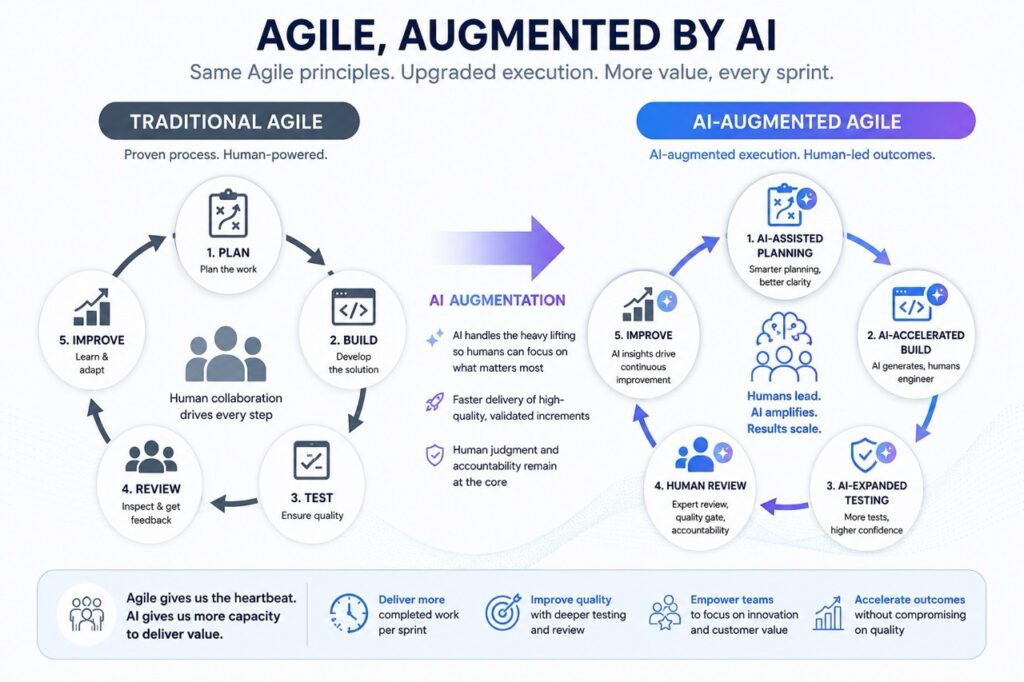
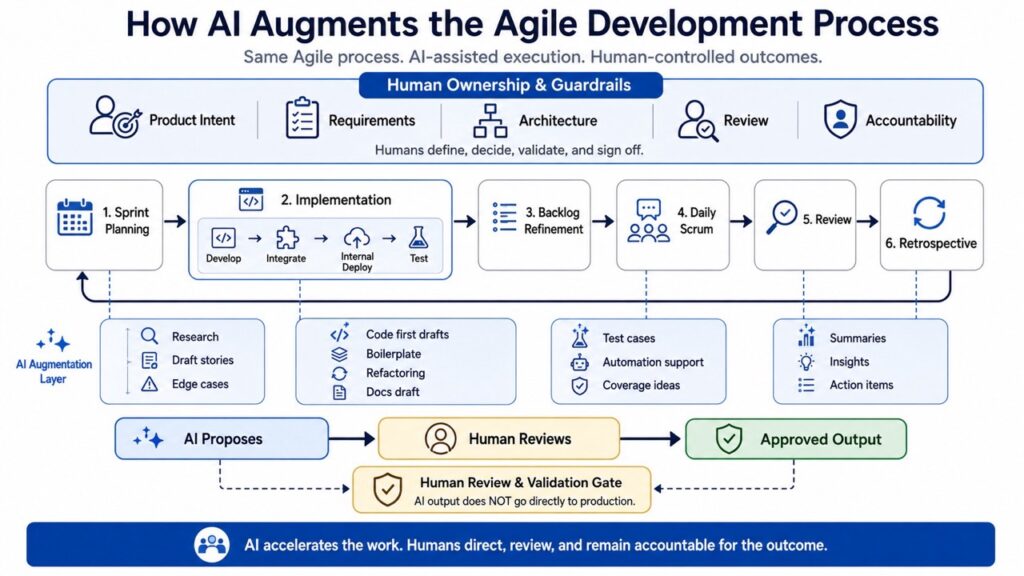
The clearest way to understand AI-augmented software development is to look inside a sprint. SupremeTech’s traditional sprint includes planning, implementation, backlog refinement, daily Scrum, review, and retrospective. AI does not need to replace any of those activities. Instead, it can increase the throughput of work around them.
Sprint Planning → Implementation → Integrate & Test → Review → Feedback → Backlog Refinement → Next Sprint
In an AI-augmented sprint, the loop stays intact. The difference is that research-heavy and generation-heavy tasks can happen faster, while review points remain fixed.
1. Sprint Planning: Turn Confirmed Requirements Into Buildable Work Faster
Sprint planning is still a team commitment, not an AI scheduling exercise. People decide what is valuable, what is feasible, what dependencies matter, and how much work the team should take on. AI can help prepare for that conversation by summarizing requirements, highlighting missing acceptance criteria, breaking a larger feature into candidate tasks, or comparing implementation approaches.
This can make planning more efficient because developers spend less time reconstructing context from scattered documents. However, the final estimate and commitment still belong to the team. AI can propose a breakdown. It cannot take responsibility for whether that breakdown is realistic in the current codebase, with the current team, under the current business constraints.
2. Implementation: AI Adds Execution Capacity to the Engineering Team
Implementation is where AI augmentation is most visible. Well-specified tasks can be accelerated with AI-generated functions, components, boilerplate, migrations, refactoring suggestions, and first-pass implementations. More advanced workflows may use multiple AI tools or agents together, with different tools handling coding, task coordination, or test scaffolding under developer direction.
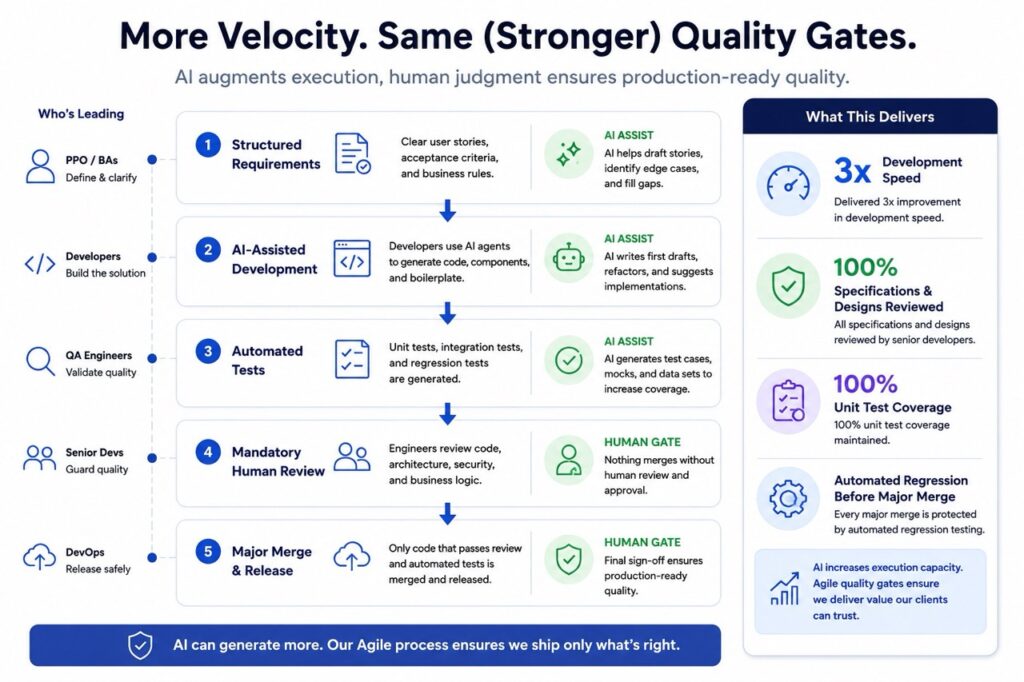
On the venue operation system project, the team used Claude Code and GitHub Copilot for code generation, with Linear supporting an agentic project-management workflow across tasks. This multi-agent approach contributed to a 3x improvement in development speed compared with the team’s typical pace.
The more important part of the result is what did not change. One hundred percent of specifications and internal designs were reviewed by senior developers before implementation, and every line of AI-generated code went through mandatory peer review before entering the codebase. Speed came from reducing repetitive and generative work. Quality control came from keeping the engineering gate in place.
This is a better way to measure AI augmentation than counting generated lines of code. The question is not how much code the model produced. The question is how much more validated product work the team was able to move through the sprint.
3. Integrate and Test: Expand Validation Without Slowing the Sprint
Traditional Agile already expects developers and QA engineers to test continuously rather than leaving quality until the end. AI strengthens this part of the loop when it is used to generate candidate test cases, cover more edge conditions, create regression scenarios, or automate repetitive verification. It can increase the breadth of validation without requiring the same increase in manual test-writing effort.
The venue operation system had a difficult concurrency problem: multiple VIP guests could attempt to reserve the same seat or venue slot during peak event traffic. AI models were used to synthesize edge-case test scripts targeting those booking race conditions and stress-load scenarios. The project paired this with automated API regression verification under ISTQB-aligned practices.
The result was 100% unit test coverage, with automated regression testing completed before every major merge. AI helped the team create and run more verification, but people still decided which business scenarios were critical, interpreted failures, and judged whether the feature was safe to release.
4. Daily Scrum and Backlog Refinement: Reduce Coordination Friction
The purpose of Daily Scrum is communication, quick decision-making, and early identification of impediments. AI should not replace that team interaction. A useful role is to reduce the administrative work around it, for example by summarizing task context, surfacing unresolved dependencies, or turning new information into draft backlog updates for the team to confirm.
The same applies to backlog refinement. New information from implementation, QA, or the business can be organized faster, but Product Owners, PPOs, BAs, and the delivery team still decide what the information means for priority and scope. AI can make the backlog easier to maintain. It should not become the owner of the backlog.
5. Sprint Review: AI Can Accelerate Work, but Stakeholders Still Validate Value
A sprint is not successful because the team generated a large amount of output. It is successful when a stable increment works, meets the intended requirement, and can be reviewed with stakeholders. That makes Sprint Review a critical human checkpoint in an AI-augmented process.
The development team can use AI extensively before this point, but stakeholders still need to see what was built, review quality and behavior, and decide whether the result solves the intended problem. This protects the Agile process from a common AI failure mode: producing technically plausible work that is disconnected from the real business need.
6. Retrospective and Kaizen: Improve the Process, Not Just the Product
Agile teams use retrospectives to reflect on what helped, what slowed the sprint down, and what should change next. AI can support this by summarizing recurring blockers, comparing sprint artifacts, grouping defects, or highlighting patterns in review comments. The team then decides what to change.
This creates an important extension of Kaizen. Traditional Agile asks the team to build, learn, and improve. AI augmentation can help the team process more information between those steps, so the loop can become build faster, learn faster, and improve faster without removing the human judgment behind the improvement.
Agile Artifacts Become the Context Layer for AI
One of the biggest misconceptions about AI-assisted development is that better tools make documentation less important. In practice, the opposite is true. AI tools do not automatically know a company’s domain, architectural history, coding conventions, product decisions, or exceptions. Their output is only as relevant as the context they can reliably access.
That makes familiar Agile and engineering artifacts more valuable, not less. A Product Backlog tells the system what work matters. A user story describes the intended behavior. Acceptance criteria define what correct looks like. Architecture decision records explain constraints and tradeoffs. Coding standards shape implementation. Test cases describe how the team verifies the result.
In a mature AI-augmented workflow, these artifacts serve two audiences at once: the people collaborating on the product and the AI tools assisting them. Good documentation reduces the amount of context developers have to recreate in prompts, improves consistency between tasks, and makes generated output easier to review against an agreed source of truth.
Human ownership is still essential here. Someone must decide what belongs in the documentation and keep it current as the product changes. Stale context can be more dangerous than missing context because both humans and AI may confidently act on information that is no longer true.
The Agile Team Becomes Human-Led and AI-Extended
AI augmentation also changes how to think about team capacity. It does not require replacing the roles in an Agile team. SupremeTech’s traditional model includes Product Owner or Product Manager, Technical Leader, Proxy Product Owner or Business Analyst, Scrum Master or Project Manager, Developers, and Quality Control Engineers. Those responsibilities remain meaningful because each role owns a different kind of judgment.
| Agile role | Where AI can extend the role | What the person still owns |
| Product Owner / PPO / BA | Requirement structuring, edge-case suggestions, document drafting | Business context, priority, scope, acceptance |
| Technical Leader | Technology research, option comparison, design exploration | Architecture direction, technical risk, final design decisions |
| Developer | Code generation, refactoring, boilerplate, debugging support | Implementation judgment, review, security and maintainability of merged code |
| QA / QC Engineer | Test-case generation, regression expansion, test-data support | Test strategy, critical business scenarios, release-quality judgment |
| Scrum Master / PM | Task summaries, coordination support, status synthesis | Team process, delivery decisions, impediment management, communication |
The practical model is therefore not “humans versus AI.” It is a human-led team with AI extending research and execution capacity around existing roles. Accountability stays attached to the people who can understand consequences and act when something goes wrong.
Release Does Not End the Agile Loop
AI-augmented development should also preserve the connection between Release and the next cycle of learning. Deployment is not simply the final technical step. SupremeTech’s traditional process treats releases such as POC, MVP, beta, and official launch as opportunities to validate the product in the market and feed what is learned back into development.
AI can assist with infrastructure-as-code configuration, release checks, monitoring and alerting rules, or anomaly detection once the system is live. Those capabilities can shorten the time between a production signal and an engineer understanding where to investigate. They do not remove the need for an owner who can judge severity, choose a response, and communicate with stakeholders.
The same principle carries into Maintenance & Kaizen. AI can help cluster defects, summarize logs and incidents, suggest candidate fixes, update documentation, or generate regression tests around a production issue. The team still decides what deserves priority and whether a proposed change is safe. The output of maintenance then becomes better context for the next iteration.
What the Real Project Shows About AI-Augmented Agile
Taken together, the anonymized venue operation project shows why the Agile framing matters. AI was not used as a standalone coding shortcut. It was applied across a sequence of existing delivery activities: structuring complex requirements, accelerating implementation, and expanding automated testing. Each accelerated activity was paired with a human or automated quality gate.
The project achieved a 3x improvement in development speed. At the same time, specifications and internal designs still received 100% senior developer review, every line of AI-generated code went through mandatory peer review, unit test coverage reached 100%, and automated regression testing ran before every major merge.
Those controls are not side notes to the productivity result. They are what make the result meaningful. Faster generation without review would simply move uncertainty downstream. In an Agile process, the goal is more validated learning and more production-ready value per iteration, not more unchecked output.
This also explains why AI augmentation can be more useful to an experienced Agile team than to a process with weak engineering discipline. The stronger the requirements, architecture boundaries, review practices, test strategy, and feedback loops are, the more safely AI can accelerate the work between them.
What Changes and What Does Not
A useful way to evaluate an AI-augmented software development process is to separate execution from accountability.
| What changes with AI augmentation | What should not change |
| Research and comparison can happen faster. | Business and technical decisions still have accountable owners. |
| Requirements can move from rough notes to structured artifacts faster. | Stakeholders still define needs and approve scope. |
| Developers can generate first-pass code instead of starting from zero. | Engineers still review and approve what enters the codebase. |
| Tests and edge cases can be generated at greater scale. | QA still decides what quality means for the product. |
| Documentation can be drafted and updated with less manual effort. | The team still maintains an accurate source of truth. |
| Monitoring and investigation can surface signals faster. | People still own incident response and production accountability. |
| More work can move through a sprint. | Sprint Review, feedback, retrospective, and Kaizen still matter. |
Common Mistakes When Turning Agile Into AI-Augmented Agile
The most common adoption mistakes happen when teams treat AI as a reason to remove parts of Agile rather than accelerate the work inside them.
Removing review because generation is faster. This reverses the logic of the model. Faster generation increases the amount of output that may need validation. Review should be a fixed quality gate, especially when deadlines are tight.
Letting AI become the source of product truth. AI should work from confirmed requirements, not invent them. If user stories, acceptance criteria, or product decisions are unclear, the right response is to resolve the ambiguity with stakeholders rather than ask the tool to guess.
Skipping documentation because the AI can read the code. Code is only one part of product context. Business rules, rejected alternatives, architectural reasoning, operational constraints, and acceptance criteria often live elsewhere. Structured context makes both humans and AI more reliable.
Applying the same level of AI involvement everywhere. Generation-heavy tasks such as implementation and test scaffolding can use substantial AI assistance. Architecture, product prioritization, release decisions, and incident response need stronger human ownership because the consequences of a wrong decision are larger.
Measuring success by generated output. Lines of code, prompts, or agent tasks are weak metrics by themselves. A better Agile measure is whether the team can deliver more accepted, tested, reviewable product value per iteration without increasing defects or rework.
A Practical Test for an AI augmented agile software development
When evaluating your own process or a software development partner, do not start by asking which AI tools they use. Start with the Agile loop and ask what happens at each checkpoint.
• Who confirms requirements before AI-assisted implementation begins?
• What project context is provided to AI tools, and where is that context maintained?
• What can AI generate during implementation, and what must a developer review before merge?
• How are AI-generated tests checked against real business risks and acceptance criteria?
• What does the team show stakeholders during Sprint Review?
• How do findings from QA, production, and retrospective feed the next backlog?
• If AI output is wrong at any stage, what catches it before the error reaches users?
A mature answer should describe both acceleration and control. If a team can explain only how AI makes coding faster, but not how requirements, review, testing, feedback, and ownership work around it, the process is not yet mature enough to call an upgrade to Agile.
Where to Go From Here
AI-augmented software development works best when it strengthens a process that already has clear roles, iterative delivery, review discipline, testing, and feedback. The goal is not to automate Agile away. It is to give an experienced Agile team more leverage while keeping the checkpoints that protect product quality and business intent.
For the traditional foundation behind this model, see SupremeTech’s Software Product Development Process
For the broader definition and adoption context, see What Is AI Augmented Software Engineering? A Complete Guide
If you are looking for AI-augmented development services, book a free consultation with SupremeTech!
FAQs Section
No. In the model described here, Agile remains the operating framework for iterative planning, implementation, testing, stakeholder review, feedback, and continuous improvement. AI augments selected activities inside that framework so the team can complete research, drafting, coding, testing, and documentation with less manual effort.
The biggest difference is the amount of execution leverage available inside a sprint. Traditional Agile relies primarily on human effort to turn context into specifications, code, tests, and documentation. AI-augmented Agile uses AI to accelerate parts of that work while keeping human ownership of priority, architecture, review, quality, and release decisions.
It can change how people spend their time, but it does not remove the need for accountable roles. Product and business roles still own requirements and priorities. Technical leaders still own architecture. Developers still review code. QA still owns quality judgment. Scrum Masters and PMs still protect the delivery process. AI acts as additional execution capacity around those responsibilities.
The largest gains usually appear in research-heavy or generation-heavy work: preparing implementation context, generating first-pass code, creating tests, summarizing technical information, and maintaining documentation. Human involvement should remain strongest wherever a decision has material business or technical consequences.
AI tools work from the context they are given. User stories, acceptance criteria, architecture records, coding standards, and test cases provide a structured source of truth that improves consistency and makes generated output easier to review. Without that context, each interaction is more likely to depend on incomplete assumptions.