








Best Tools to Analyze Customer Data for Persona Creation: A Practical Guide
24/09/2026
7
The best tools to analyze customer data for persona creation do not belong to one software category. Analytics tools show what customers do, while surveys and interviews help explain why they do it. CDP, CRM and BI systems connect those findings to customer history, segment size and business value.
Using only one source produces an incomplete persona. Behavioral data can identify a pattern without explaining the customer’s motivation. Interviews provide context, but a few conversations cannot show how common that behavior is across the customer base.
A reliable persona connects both sides. It represents a measurable customer group and supports its goals, barriers and needs with research evidence.
This guide compares six functional tool categories and explains how to combine them into a practical persona creation workflow. It focuses on selecting the right evidence, not promoting individual vendors.
Data-Backed Personas Need Behavior and Explanation
A data-backed persona represents a real customer segment using evidence rather than assumptions. It should help a team make a decision about product design, messaging, service or customer experience.
Research on data-driven personas describes a shift from static profiles toward decision tools connected to digital user data and analytics. This makes personas more precise and interactive, but data volume alone does not create customer understanding. Read the research on data-driven personas.
Different data sources answer different questions:
| Evidence | Main question answered |
| Website or app events | What did the customer do? |
| Transaction data | What did the customer buy, return or spend? |
| CRM and service history | What relationship has the customer had with the business? |
| Survey responses | What does the customer say matters? |
| Interviews | Why did the customer act that way? |
| AI-assisted synthesis | What themes appear across a large body of approved evidence? |
A useful persona connects these answers. It does not turn demographic assumptions into a fictional biography.
Six Tool Categories for Persona Creation
The right stack depends on the evidence gap. Start by identifying what the team needs to learn, then select the category that can answer that question.
| Tool category | Best used for | Typical output | What it cannot prove alone |
| Behavioral analytics | Understanding web, app and product activity | Events, paths, funnels and engagement patterns | Customer motivation |
| CDP or CRM | Connecting activity with customer profiles and relationship history | Identifiable segments and interaction timelines | Whether a pattern explains a real need |
| Business intelligence | Comparing data across sources | Segment size, trends and cross-channel comparisons | The reasons behind the numbers |
| Surveys | Measuring stated preferences across a larger sample | Ratings, selections and open-text responses | Actual behavior |
| Interviews and research repositories | Exploring goals, barriers and decision context | Notes, recordings, themes and supporting quotes | How common each finding is |
| AI synthesis | Organizing and summarizing approved research material | Draft themes, coded responses and evidence summaries | Whether a claim is true |
Behavioral analytics tools
Behavioral analytics tools help teams identify groups based on observable activity. A retailer might find customers who repeatedly view a product, check store availability and later purchase in a physical store.
Look for event-level exports, flexible segment definitions and consistent customer identifiers. A polished dashboard is less useful when the underlying events cannot be connected to other sources.
CDP and CRM systems
A CDP or CRM helps connect behavior with known customer history. This may include purchases, loyalty status, service interactions and campaign responses.
The article does not need to repeat the differences between these systems. What matters for persona creation is whether the system can produce a traceable customer group that researchers can analyze and recruit from.
Business intelligence tools
BI tools help analysts compare candidate personas across channels, periods and business outcomes. They can show whether an apparent behavior represents a meaningful segment or only a small number of unusual customers.
Useful capabilities include reusable data models, drill-down analysis, controlled definitions and access to source-level records.
Survey tools
Surveys help test whether an attitude or reported need appears across a wider sample. They are useful after analytics or interviews have produced an initial hypothesis.
Include behavioral screening questions where possible. Asking what customers recently did produces stronger evidence than asking what they believe they usually do.
Interview and research tools
Interview tools should support recruitment, consent, recording, note-taking, coding and evidence retrieval. The goal is not simply to store transcripts. Teams need to find the observations supporting each persona claim.
GOV.UK recommends using open, neutral questions and focusing on real stories rather than how participants think an experience should happen. Review its guidance on in-depth interviews.
AI synthesis tools
AI can group open-text responses, suggest codes, summarize interviews and find possible themes. It is most useful after the research question and evidence structure have been defined.
Use an approved environment and remove unnecessary identifying information. Keep the source passage connected to every generated theme, and require a researcher to review the result.
NIST identifies false but confidently presented content, privacy and weak data provenance as risks when using generative AI. It recommends reviewing sources and citations and documenting human oversight. Review the NIST Generative AI Profile.
Read more:
- Customer Data Management Software: What It Does, How to Choose It, and How to Implement It
- CDP Platforms: What They Do and How to Choose the Right One
How to Combine the Tools in Seven Steps
Step 1: Define the decision the persona must support
Start with a decision, not a persona template. A retailer might need to improve the online-to-store handoff, redesign loyalty onboarding or reduce abandonment during repeat purchases.
Define the audience, decision owner and expected action. These requirements determine which behaviors and research questions matter.
Step 2: Build candidate segments from behavioral data
Use analytics and transaction data to identify distinct patterns. Define each candidate segment with observable rules instead of labels such as “busy shopper” or “digital native.”
A candidate segment might include customers who viewed the same product several times, used the store locator and completed an in-store purchase within 14 days. The definition can be measured and tested.
Do not add motivations yet. Behavioral data shows the sequence, not the reason behind it.
Step 3: Connect the behavior to customer history
Use the available CDP, CRM or customer profile layer to connect each behavioral segment with relevant purchase, loyalty and service history.
Check whether the identifiers and source data are reliable before drawing conclusions. If one customer appears as several profiles, the apparent segment size and behavior may be wrong.
This article does not repeat identity resolution or customer analysis methods. Those topics are covered in the related guides below.
Read more:
- Unified Customer Profile: How Retailers Build a Reliable Customer View
- Customer Data Analysis for Japanese Retail: A 7-Step Omnichannel Guide
Step 4: Use BI to test the business importance
Compare the candidate segments by size, frequency, value, retention, channel use or another metric relevant to the decision.
The goal is not to select only the highest-value customers. A smaller group may represent a serious experience gap or an important growth opportunity. BI helps show whether the pattern is stable enough to justify further research.
Record the segment query and reporting period so the analysis can be repeated later.
Step 5: Recruit survey and interview participants from the segments
Recruit participants who match the behavioral rules. This connects qualitative research to customers who actually demonstrated the activity being studied.
Use surveys to test the distribution of known questions. Use interviews when the team needs to understand context, workarounds, expectations or barriers.
Ask participants about specific recent experiences. “Tell me about the last time you checked a product online before visiting a store” is more useful than “Do you prefer omnichannel shopping?”
Step 6: Synthesize findings without losing the evidence
Separate observations from interpretations. An observation may show that a participant called a store after checking online stock. The interpretation may be that the customer did not trust the availability information.
GOV.UK’s research-analysis guidance recommends capturing what researchers saw or heard before grouping observations into themes and findings. It also advises involving multiple observers to reduce individual bias. See the research-analysis process.
AI may help group responses or find repeated language, but each theme should retain:
- Source record or participant ID
- Supporting behavior
- Supporting research excerpt
- Research date
- Analyst or reviewer
- Confidence level
Step 7: Build, validate and maintain the persona
Write the persona only after behavioral and qualitative evidence have been compared.
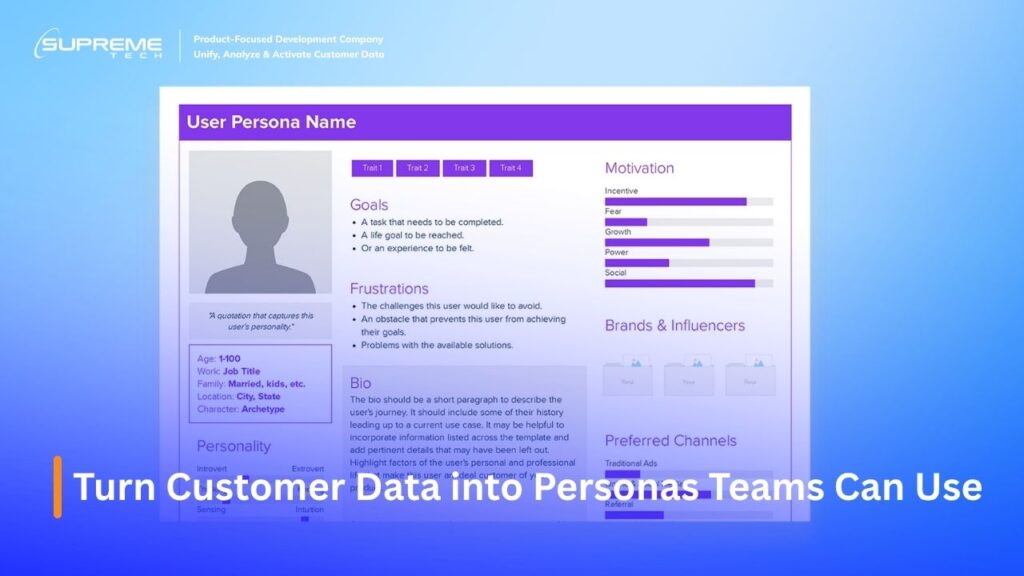
A useful persona should contain:
- Measurable segment definition
- Observed behaviors
- Goals and desired outcomes
- Barriers and decision triggers
- Relevant channels or touchpoints
- Supporting research evidence
- Confidence level
- Last review date
- Business decisions it should support
Validate the persona against new customers and future behavior. Update or retire it when the defining behavior, customer need or business context changes.
What a Persona Evidence Matrix Looks Like
The following illustrative example shows how a retailer could document a persona called “Research-First Store Buyer.”
| Persona claim | Behavioral evidence | Qualitative evidence | Confidence |
| Researches products online before visiting a store | Product views followed by store-locator use and an in-store purchase | Participants described checking details before deciding whether a trip was worthwhile | High |
| Needs confidence that the product is available | Repeated stock-page visits before the store visit | Interviews identified concern about arriving after an item had sold out | High |
| Values staff confirmation for complex purchases | Purchase completed in-store after digital research | Participants wanted advice before making the final decision | Medium |
How to Choose the Right Tool Stack
Do not buy six new platforms before checking what the company already has.
| Data maturity | Practical starting stack |
| Early stage | Web analytics, survey tool, interview notes and a spreadsheet or basic BI tool |
| Growing multichannel business | Analytics, CRM or CDP, BI, survey platform and research repository |
| Mature omnichannel business | Unified profile layer, governed data model, BI, research repository and controlled AI synthesis |
Evaluate individual tools based on:
- Access to raw or exportable data
- Integration with the existing data stack
- Identity and consent controls
- Evidence traceability
- Qualitative coding support
- Role-based access
- Data residency and security requirements
- Ongoing operating cost
- Ability to update personas as evidence changes
A tool should solve a defined evidence or workflow problem. Feature count alone is not a selection strategy.
Common Persona Tool Mistakes
- Starting with the template: A polished profile cannot repair weak evidence.
- Using analytics alone: Behavior does not explain goals or barriers.
- Using interviews alone: A few conversations cannot size a segment.
- Confusing a segment with a persona: A segment identifies a group. A persona adds evidence about its context and needs.
- Accepting AI-generated claims: AI summaries must remain linked to source material and human review.
- Leaving personas unchanged: Profiles lose value when customer behavior or market conditions shift.
- Buying tools before defining ownership: Someone must maintain segment rules, research evidence and review dates.
Turn Customer Data into Personas Teams Can Use
The best persona stack connects observed behavior with customer context and qualitative evidence. Analytics finds patterns, customer systems connect history, BI tests scale, research explains motivation and AI helps organize the material.
The final persona should remain connected to a measurable segment and traceable evidence. Otherwise, it becomes another presentation that teams stop using.
SupremeTech helps retailers connect customer data across POS, e-commerce, loyalty and customer applications. Explore our omnichannel retail solutions or contact our team to discuss the data foundation behind your customer research.
FAQs Section
The best stack combines behavioral analytics, a CRM or CDP, BI, survey software, an interview repository and controlled AI synthesis. The right combination depends on whether the team needs behavioral patterns, customer context, segment sizing or qualitative explanations.
No. Analytics can identify what customers did, but it rarely explains their goals, concerns or decision context. Interviews and surveys are needed to interpret the behavior and test whether the explanation is supported by customer evidence.
No. A team can begin with analytics, CRM data, surveys and interviews. A CDP becomes more useful when customer activity is fragmented across several channels and the business needs repeatable identity resolution and segment updates.
AI can organize open-text responses, suggest themes and summarize approved research material. It should not create unsupported persona characteristics. Every AI-generated finding should remain linked to its source and receive human review.
Review personas when important customer behavior, products, channels or market conditions change. Teams should also assign a regular review date and monitor whether the segment definition still identifies a meaningful customer group.