









What Is AI Augmented Software Engineering? A Complete Guide
26/08/2026
304
What AI Augmented Software Engineering Means
AI augmented software engineering is the practice of using AI tools, including code generation assistants and autonomous coding agents, inside an established software development process, with humans still owning requirements, architectural decisions, and final accountability for the shipped product. It is an accelerant applied on top of traditional engineering discipline.
That distinction matters more than it might sound. Over the past two years, the term “AI augmented” has started showing up everywhere: in job postings, vendor pitches, and conference keynotes, often without a consistent definition attached. Some people use it to mean any developer who occasionally asks an AI tool for a code suggestion. Others use it to describe teams that have restructured their entire delivery process around AI-generated output. Both usages exist, but only one of them describes a repeatable, professional practice that a business can actually rely on to ship production software.
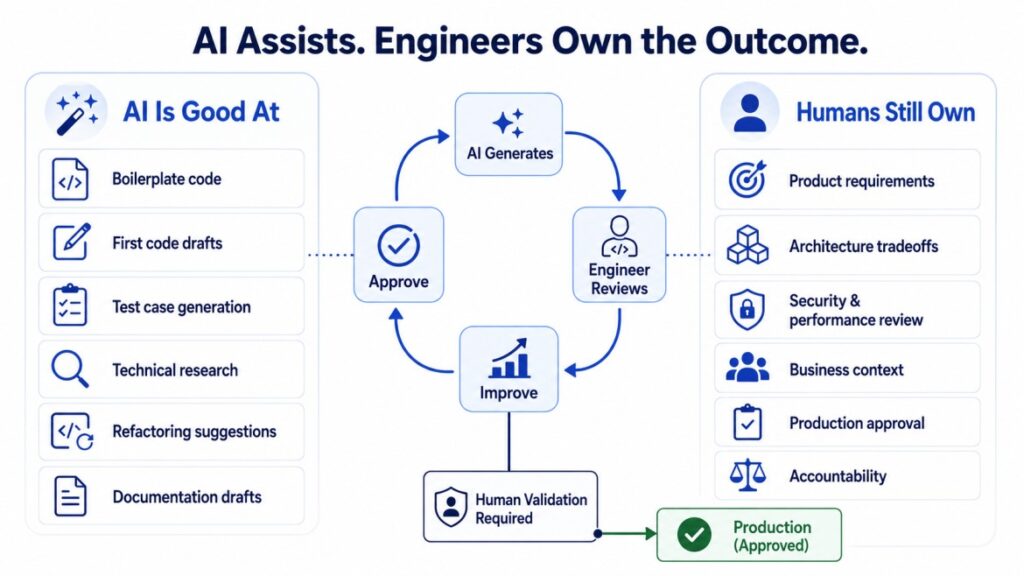
The core idea is simple. AI is treated the way you would treat a highly capable but junior team member. It’s fast, knowledgeable across a huge range of topics, and genuinely useful, but not yet trustworthy enough to work without oversight. Three things stay constant no matter how much AI involvement a team adopts:
- Human-in-the-loop throughout requirements definition process. AI can support writing user stories and test cases, but understanding what a business actually needs, resolving conflicting stakeholder priorities, and deciding what to build first are not tasks an AI model can reliably do on its own. Only people can translate the context in their heads into the valuable, business-oriented and customer-centric requirements.
- Humans make architectural decisions. Choosing a database strategy, a service boundary, or a security model involves tradeoffs that play out over years, not just the current sprint. AI can summarize options quickly, but the decision itself carries consequences an AI model has no stake in and no way to fully evaluate.
- Human accountability for the shipped product. Somebody has to be able to explain why a system behaves the way it does, sign off on a security review, and take responsibility if something goes wrong in production. That responsibility cannot be delegated to a tool.
Everything else is where AI augmentation actually happens, and where the productivity gains show up.
A short history of how we got here
Before moving on to other terms related to AI-augmented software engineering, let’s take a trip back to the evolution of AI since its dawn.
The first wave of AI era was autocomplete. For example, tools that predicted the next few characters or lines based on pattern matching. It’s linguistically useful, but limited to syntax, not logic.
The second wave, starting around 2021, introduced code assistants that could generate whole functions from a natural language prompt or a comment, trained on large volumes of public code. This is the era most people still picture when they hear “AI coding tool.”
The third wave, which is where the industry sits now, introduced coding agents: AI systems that can plan a multi-step task, edit multiple files, run commands, and iterate on their own output with limited supervision, coordinating with other tools such as project trackers along the way. This is what people usually mean today when they say “agentic development,” and it is the wave that has made the question of process discipline urgent, because agents can now do a lot more damage a lot faster if nobody is checking their work.
The widespread use of AI systems like these lowered the entering barrier for non-tech coders. GitHub’s platform grew by more than 36 million developers in 2025 alone, the fastest absolute growth rate in the platform’s history, and public repositories that import an AI model SDK grew 178% year over year. That kind of growth curve happens when a practice has become close to a baseline expectation across the industry.
AI augmented software engineering is the set of practices that have grown up around managing that third wave responsibly. It did not emerge from a single framework or vendor; it emerged because teams needed a way to capture the speed of agentic tools without inheriting their failure modes.
AI Augmented Engineering vs Vibe Coding vs Full Automation
Confusion between these three terms is probably the single biggest source of miscommunication when a business tries to evaluate an AI powered development partner, so it is worth being precise.
Vibe coding describes a workflow where a non technical or lightly technical user describes what they want in plain language and lets an AI tool generate most or all of the application. It prioritizes speed and low barrier to entry over long term maintainability, security, or scalability. It is genuinely useful for prototypes, internal tools, and testing an idea quickly. It is not designed for production systems that need to survive contact with real users, real data, and real failure modes.
Full automation, sometimes called unsupervised AI development, refers to a methodology that lets an AI agent generate and deploy code with no meaningful human review step. In practice this is rare in professional settings today, precisely because of the risk it introduces, but it does show up in low stakes internal scripts or in early stage experiments where the cost of a mistake is low.
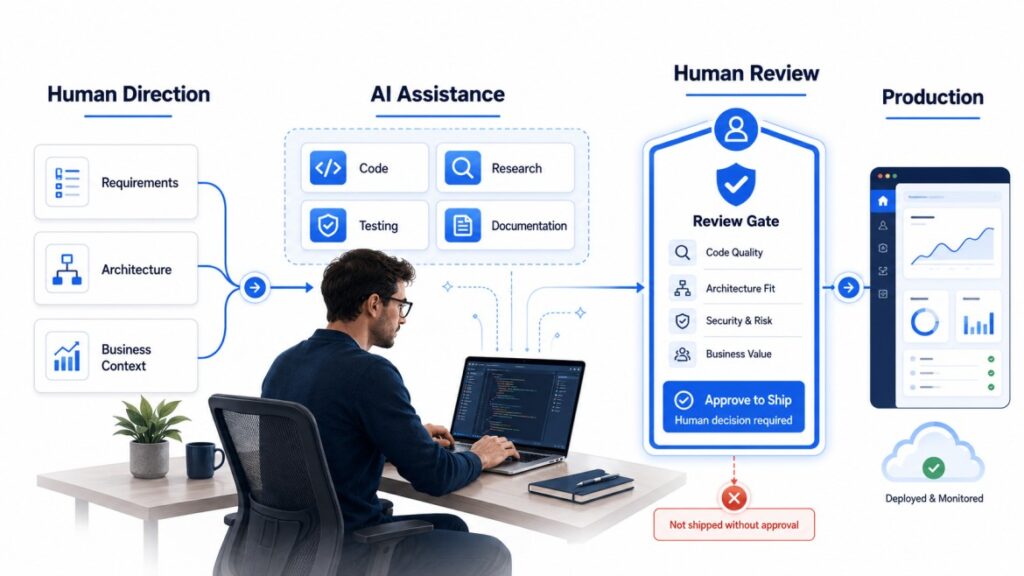
AI augmented software engineering sits between these two, closer to full automation in terms of how much AI is actually doing, but structured with the same rigor as traditional professional software development: defined requirements, architectural review, testing standards, and a mandatory human review step before code reaches production.
| Dimension | Vibe Coding | AI Augmented Engineering | Full Automation (Unsupervised) |
|---|---|---|---|
| Typical user | Non technical or early stage founder | Professional engineer or engineering team | Rare in production; used for low stakes internal tooling |
| Review process | Minimal or none | Structured human review at defined checkpoints | None by design |
| Best suited for | Prototypes, MVPs, internal experiments | Production systems, client facing software, regulated environments | Disposable scripts, sandboxed experiments |
| Documentation standard | Usually none | Treated as a required deliverable, not an afterthought | Usually none |
| Risk profile | High if pushed to production without rework | Managed through process, comparable to traditional development | High, and largely unmanaged |
| Where output typically lands | Prototype or throwaway build | Live production systems | Internal or experimental use only |
The practical takeaway: if a vendor or team cannot describe a specific human review step in their AI development process, they are likely doing some version of vibe coding regardless of what they call it, and that matters a great deal if the software is headed to production.
It also helps to think about this in terms of what each approach is actually optimized for. Vibe coding optimizes for speed to a working demo, and it is genuinely the right tool for that job; trying to force a heavy, documentation driven process onto a weekend prototype wastes time nobody has budgeted for. AI augmented engineering optimizes for speed without sacrificing the properties a production system needs to survive real usage: security, maintainability, and the ability for a different engineer to pick up the codebase six months later and understand it. Full automation, when it appears in professional settings at all, tends to optimize for one thing only, throughput, and accepts the risk that comes with it. None of these is universally “better.” They are suited to different jobs, and the mistake most often made in practice is applying the wrong one to a production system because the speed of vibe coding or full automation looks appealing without accounting for what gets sacrificed to get it.
Where AI Fits Across the Agile Development Lifecycle
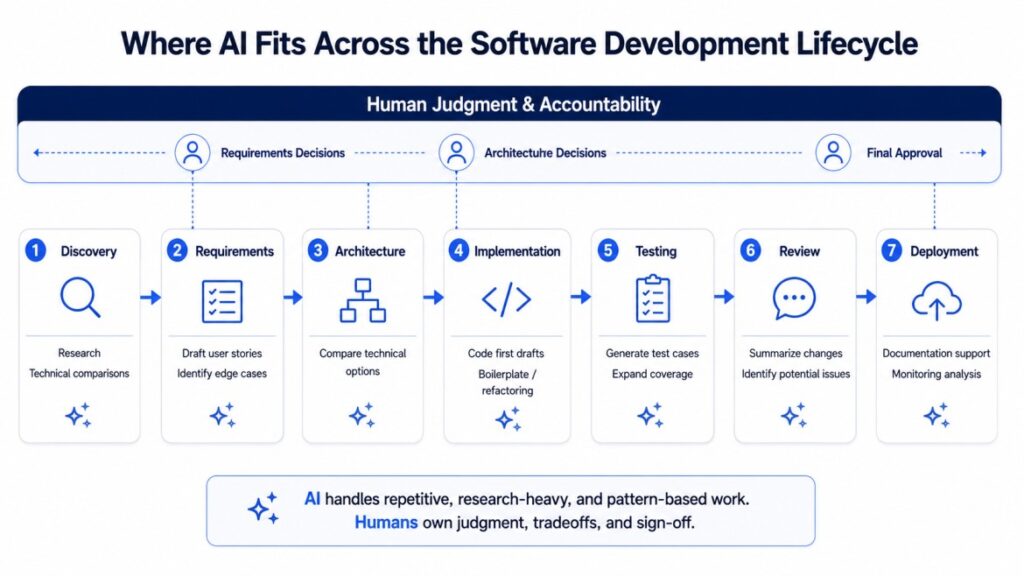
AI augmented engineering does not skip any phase of a standard software development lifecycle. It changes how much time each phase takes and what a human is actually doing during that phase. At a high level, the phases look like this:
Discovery and research, requirements and business analysis, architecture and technology stack decisions, documentation, implementation, code review and test automation, and deployment and monitoring.
In each of these phases, AI typically handles the research heavy, repetitive, or pattern based portion of the work, while a human continues to own judgment calls, tradeoffs, and final sign off. The balance shifts phase by phase. Requirements gathering stays mostly human with AI support on edge case identification. Implementation shifts much further toward AI generated first drafts, with human review carrying more of the weight. Testing sits somewhere in between, with AI generating test cases and a human validating coverage and edge cases that matter for the specific business.
A full breakdown of exactly what happens at each phase, including a real project example, is covered in How AI Augmented Software Engineering Works: A Phase by Phase Breakdown of the SDLC. That article is the natural next read if you want the operational detail behind this overview.
Why AI-Augmented Software Engineering Matters Now: What the Data Actually Shows
The honest answer to “does AI actually help software teams” is: it depends, and the data from 2025 makes that dependency very visible rather than something to take on faith.
Adoption is close to universal. GitHub’s 2025 Octoverse report, drawing on its base of more than 180 million developers, found that nearly 80% of new developers adopted GitHub Copilot within their first week on the platform, and that repositories importing an LLM SDK grew 178% year over year. AI assisted coding has effectively become a default expectation for new developers rather than an optional add on.
Adoption and trust are moving in opposite directions. Stack Overflow’s 2025 Developer Survey, based on more than 49,000 responses across 177 countries, found that 84% of developers now use or plan to use AI tools, up from 76% the year before. At the same time, only 29% said they trust the accuracy of AI output, down from roughly 40% the previous year, while 46% said they actively distrust it. A closely related finding from the same survey is that 66% of developers report AI solutions that are “almost right, but not quite,” a frustration common enough that debugging AI generated code takes longer than writing it from scratch for 45% of respondents.
The size of the productivity gain depends heavily on task complexity. McKinsey’s research on generative AI in software development found that AI tools could cut time spent on routine, well defined coding tasks by as much as 46%. That number shrank to under 10% on tasks developers rated as high in complexity, often because the AI lacked familiarity with a specific framework or unfamiliar part of the codebase. A similar pattern showed up for junior developers with less than a year of experience, where some tasks actually took 7% to 10% longer with AI assistance than without it.
It is worth adding one more layer of nuance here, because the picture is not uniformly negative. McKinsey’s research also found that when developers actively iterated with AI tools rather than accepting the first suggestion, code quality measures such as bug rates, maintainability, and readability came out marginally better than fully manual code, not worse. The pattern across nearly all of this research points to the same conclusion from a different angle: the review and iteration step is where most of the real value gets created. The AI generates a starting point; the human interaction with that starting point is what determines whether the final result is actually good.
Put together, this data tells a consistent story: AI augmented software engineering delivers real value, but the value is conditional. It depends on the type of task, the experience level of the person using the tool, and critically, how much structured human review sits around the AI’s output. Teams and organizations that treat AI as an unsupervised replacement for engineering judgment are working against the data, not with it.
A full statistical breakdown, including how to interpret vendor reported productivity numbers responsibly, is available in AI Augmented Software Engineering by the Numbers: ROI, Adoption, and Benchmark Data.
What AI Is Actually Good At (and Where It Still Needs a Human)
It is worth being specific here rather than vague, because vague claims in either direction, “AI can do everything” or “AI can’t be trusted with anything,” are both wrong and both unhelpful to a team trying to make a real decision.
Where AI genuinely helps:
- Generating boilerplate and repetitive code structures
- Producing a first draft of a function, class, or component from a clear specification
- Writing and expanding test cases, particularly for edge cases a human might not think to check manually
- Summarizing and comparing technical options during research
- Refactoring suggestions for readability and consistency
- Drafting documentation from existing code, then having a human verify and refine it
Where a human still needs to own the outcome:
- Deciding what the product actually needs to do and in what order
- Making architecture and technology tradeoffs that play out over years
- Reviewing AI generated code for security, performance, and integration risk
- Understanding an unfamiliar, high context, or legacy codebase well enough to modify it safely
- Taking responsibility for what ships to production
A randomized controlled trial run by METR in 2025, one of the few pieces of evidence in this space based on controlled experiment rather than survey data, found that experienced open source developers working in codebases they knew well were measured as 19% slower when allowed to use AI tools, despite believing beforehand that AI would make them 24% faster, and estimating afterward that it had made them 20% faster.
The gap between what developers believed and what was actually measured is exactly why structured review matters more than developer confidence when a team decides how much to trust AI output. It is also why METR flagged the result as a snapshot of a specific set of tools and tasks rather than a permanent verdict on AI coding assistance; the same research group later found meaningfully different results as tools and developer familiarity with them evolved.
How the Developer Role Is Changing
One side effect of AI augmented engineering that gets less attention than it deserves is what it does to the shape of a developer’s skillset over time.
For most of software engineering’s history, depth in a single specialty, a particular language, framework, or system, was the clearest path to seniority. AI augmented engineering does not remove the value of that depth, but it puts more weight on a second dimension: breadth across the surrounding disciplines that used to sit outside a typical developer’s job description. Prompting and directing AI tools effectively is itself a skill, distinct from writing code by hand. Reviewing AI generated output for subtle correctness and security issues is a skill, and a different one than writing that code from scratch. Understanding enough about product requirements, system design tradeoffs, and even user experience to judge whether an AI’s suggestion actually fits the business need is increasingly part of the job, not a “nice to have” reserved for product managers.
This shows up differently depending on seniority. Junior developers still need to build real fluency in the fundamentals, because reviewing and validating AI output requires understanding what correct code actually looks like in the first place; skipping that step in the name of speed tends to produce developers who can direct a tool but cannot catch it when the tool is wrong. Senior and staff level engineers, by contrast, increasingly spend more of their time on system level judgment, architecture, and defining the guardrails an entire team operates within, delegating a larger share of the line by line implementation work to AI, with human review remaining the constant across every level.
None of this changes what makes someone a strong engineer. It changes where that strength needs to show up.
Who Actually Uses AI Augmented Software Engineering
In house engineering teams are the most common adopters, typically starting with individual developers using AI assistants inside their existing IDE on their own initiative, long before there is any official company policy about it. Formal adoption tends to follow a predictable path from there: a few early experiments show measurable results, a team lead or engineering manager notices, and the practice gets written into team standards, often starting with something as simple as a rule about mandatory review of AI generated pull requests before it expands into fuller documentation and tooling standards.
Outsourced and agency delivery teams have a strong commercial incentive to adopt AI augmented practices early, since faster delivery without a drop in quality is a direct competitive advantage in a crowded market. This is also where the risk of cutting corners is highest, because a client typically cannot see what is actually happening inside a vendor’s process the way an internal engineering manager can see it inside their own team. A vendor under deadline pressure has every incentive to lean harder on AI generation and quietly lighten the review step, and unless the client knows what to ask, that shift can be invisible until a problem shows up in production. This is exactly the gap covered in How to Evaluate an AI Augmented Software Engineering Team or Vendor: A Buyer’s Framework and in In House vs Outsourced AI Augmented Engineering: Which Model Fits Your Team?
Freelancers and small teams tend to be the fastest adopters simply because they have the fewest approval layers to work through before trying a new tool or workflow. The tradeoff is that they also tend to have the least formal documentation of their process, since a solo developer or a two person team rarely has the same institutional pressure to write things down that a larger organization does. That is worth asking about directly if you are hiring a freelancer or small studio for work that needs to hold up over time, rather than assuming a lean team automatically means a lean or informal process.
To see what this looks like in a real, high stakes commercial project rather than in the abstract: a custom, enterprise grade venue operation system built for an elite Japanese hospitality provider used AI across requirements analysis, a multi agent development process, and automated test generation, while keeping a mandatory human review step on every single line of AI generated code before it was allowed into the codebase. The full workflow behind that project, including the exact tools and review checkpoints used, is broken down phase by phase in How AI Augmented Software Engineering Works and the complete case study is available here.
Common Misconceptions
“AI writes all the code, so developers just approve it.” In a well run AI augmented process, developers are still writing significant amounts of code themselves, particularly for anything requiring business context or architectural judgment, while directing AI toward the more mechanical parts of implementation. The ratio shifts by project, not by a fixed rule.
“AI augmented development is inherently faster but less rigorous.” This is one of the most common and most damaging misconceptions, because it assumes speed and rigor are a tradeoff rather than a design choice. In practice, a well structured AI augmented process can hold both at once. On the case study project referenced above, the team achieved a 3x improvement in development speed while still maintaining 100% specification and design review by senior developers, and 100% unit test coverage with automated regression testing before every major merge. Speed came from the tooling; rigor came from the process wrapped around it. Neither happened automatically or by accident.
“AI augmented engineering is basically the same as vibe coding, just for professionals.” The confusion is understandable given how both terms entered common usage around the same time, but the comparison table earlier in this article shows exactly where they diverge: review discipline, documentation standards, and what kind of system the output is actually fit for.
“Once you adopt AI tools, the productivity gain is immediate and permanent.” The data does not support this either. METR’s research found that the same group of developers who measured 19% slower with early 2025 AI tools showed a meaningfully different result roughly a year later, as both the tools and the developers’ familiarity with them improved. The gain is real, but it tends to build over time as a team learns where AI genuinely helps and where it does not, rather than arriving instantly the day a tool gets installed.
How to Know If a Team Is Doing This Well
A few quick signals are worth checking before you assume a team’s “AI augmented” claim matches the definition used in this article:
- Can they describe a specific human review checkpoint before code reaches production, not just “we review everything”?
- Do they produce structured documentation (requirements, architecture decisions, test plans) as a standard deliverable, or only when asked?
- Can they show testing coverage numbers, and are those numbers independently verifiable rather than self reported in a sales conversation?
- Do they have any third party certifications (security, quality, or delivery methodology) that back up their process claims?
A complete scorecard for evaluating a team or vendor against these questions, including what a strong answer looks like for each one, is covered in How to Evaluate an AI Augmented Software Engineering Team or Vendor: A Buyer’s Framework.
FAQs Section
No. Vibe coding typically involves non technical users building quickly with AI, with little to no formal review process, and is best suited for prototypes rather than production systems. AI augmented software engineering keeps the structure of professional development, including requirements, architecture review, and mandatory human code review, while using AI to accelerate specific tasks inside that structure.
No. Developers remain responsible for requirements decisions, architectural tradeoffs, code review, and production accountability. AI shifts how developers spend their time rather than removing the need for them. Several of the sources cited in this article, including Stack Overflow’s 2025 survey, found that developers still overwhelmingly want to consult another human, not an AI, in situations where they don’t trust the AI’s answer.
It depends on the project and the vendor, but the honest framing is that AI reduces time spent on certain categories of work (routine coding tasks saw up to 46% time savings in McKinsey’s research) while adding time elsewhere, particularly in review and validation. Teams that market flat, unconditional cost reductions without acknowledging this tradeoff are usually oversimplifying.
Common categories include AI code assistants integrated into an IDE, autonomous coding agents that can plan and execute multi step tasks, AI powered research tools for technical comparisons, and AI assisted testing tools that generate test cases. The specific tools vary by team; what matters more than the tool list is the review process wrapped around them.
It can be, provided it goes through the same or a more rigorous review process as human written code. AI generated code carries the same categories of risk as any code (security flaws, performance issues, maintainability problems), plus an additional risk of confidently wrong output that reads as correct at a glance. This is why a mandatory human review step before merge is considered a baseline requirement, not an optional safeguard, in professional AI augmented practice.
Low code and no code platforms provide pre built components and visual interfaces that limit what you can build in exchange for speed and simplicity. AI augmented software engineering uses AI to accelerate custom code development within a traditional engineering stack, with no inherent limit on what can be built, at the cost of still requiring engineering expertise to direct and review the work.
Track the same delivery metrics you would track without AI (cycle time, defect rate, code review turnaround, production incident rate) rather than relying on developer reported speed alone, since self reported productivity gains have repeatedly diverged from measured results in controlled research. A team that is genuinely benefiting from AI augmentation should be able to show that in its normal delivery metrics, not just in anecdotes.