





Legacy System Modernization: AWS Cloud Migration and Database Upgrade for a Luxury Automaker’s Websites in Japan
Project Overview
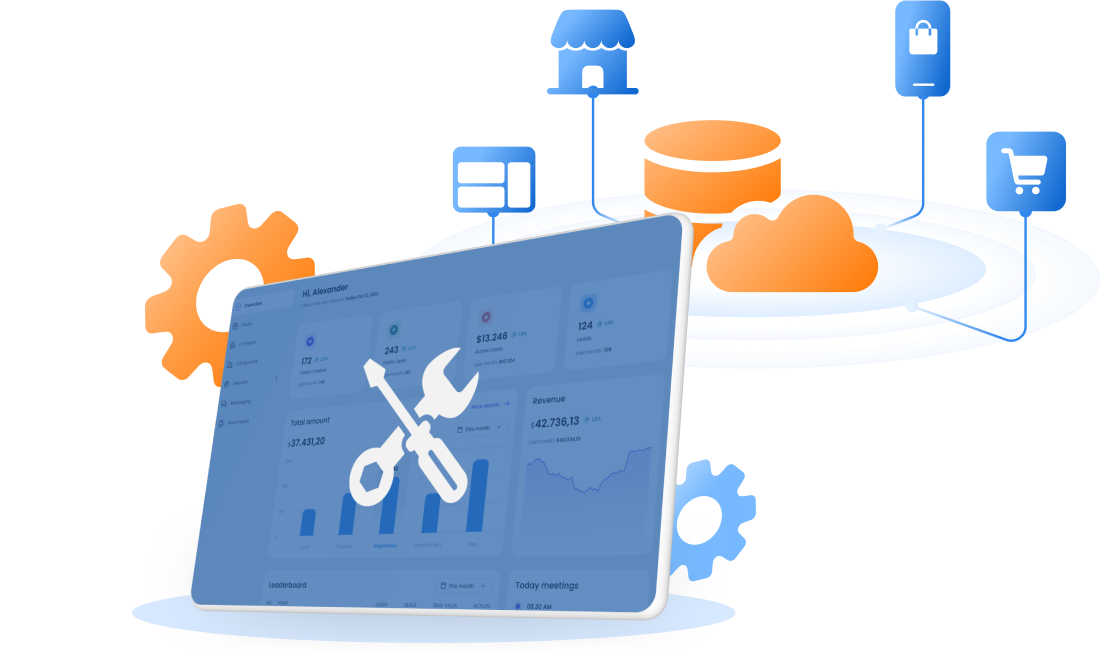
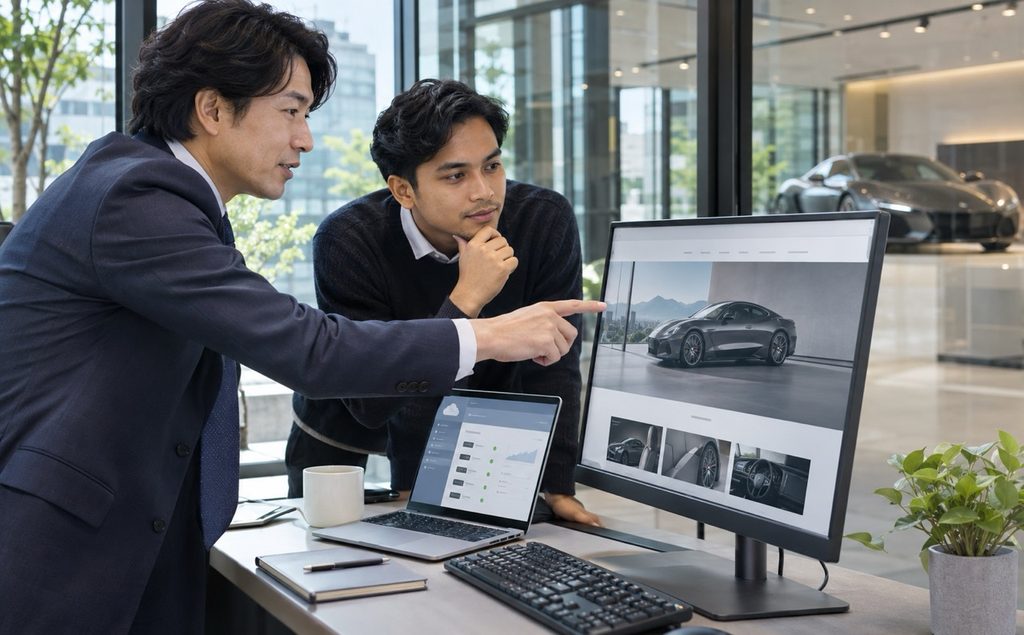
SupremeTech helped the Japan subsidiary of a global luxury automaker move six web platforms off aging local servers and onto Amazon Web Services (AWS). Working with Classmethod, our Japanese technology partner, we applied our expertise in legacy system modernization and cloud migration to make the platforms more secure, less costly to operate, and easier to maintain, while keeping them available to customers and dealers
This case study covers two web systems that serve different purposes: the brand’s marketing websites in Japan and the online portal of its test driving center in Tokyo. Both systems faced the same problems.
The two systems in this case study
| System | What it does | Who uses it | What we delivered |
| Marketing websites | Dealer websites with a content management system (CMS), customer inquiry forms and their admin, the main homepage, and campaign landing pages | Dealers, the marketing team, and customers looking for information or sending inquiries | Cloud migration to AWS, then database upgrade |
| Driving experience center portal | A customer-facing portal and a staff admin portal for the brand’s experience center in Tokyo, used for visitor reservations and driving program bookings | Visitors and center staff | Cloud migration to AWS, then database upgrade |
Although the two systems served different purposes, both faced the same problems and required the same modernization work. We therefore used one approach for both systems and presented them together in this case study.
The Problem
Both systems are part of how the brand reaches customers in Japan. Dealers publish content, customers send inquiries, and visitors book experiences online. Any change to the technology behind them had to keep these services available.
- Outdated servers with no recent maintenance: The websites ran on local servers that had not been maintained for more than a year. They were expensive to operate and harder to keep secure.
- Security weaknesses in the CMS and forms: The content management system and the customer inquiry forms had known security weaknesses. These are the parts of the websites that handle customer messages.
- Protect sensitive customer data: The websites hold personally identifiable information (PII). This data had to be migrated under the security policy and PII guidelines, without being exposed at any point.
- Live websites and several teams involved: The websites had to stay available during the move. Pointing the website addresses to the new servers also had to be coordinated with the client’s global headquarters. In addition, only approved server addresses were allowed to send email and transfer files.
- A database version without vendor support: After the move to AWS, the database version behind the websites reached its “end of life”. This means the vendor stops releasing security patches and bug fixes for that version, so the websites would become more exposed to security risks over time.
The Solution
SupremeTech worked as the development and infrastructure team, alongside Classmethod. We delivered the work in two projects: the AWS migration and the database upgrade. Both projects covered the two systems and followed a three-phase process, with testing before each switch.
Project 1: Moving six web platforms from local servers to AWS
The goal was to move both systems to AWS, bring their software up to date, fix the security weaknesses, and migrate sensitive customer data in accordance with the security policy and PII guidelines.
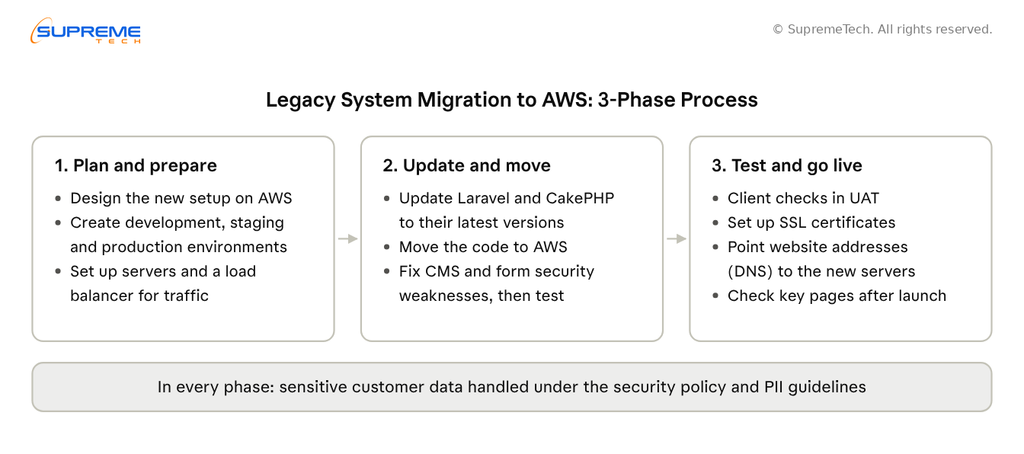
- Plan and prepare: We designed the new setup on AWS and created separate environments for development, staging (testing) and production (the live websites). The websites run on Amazon EC2 servers in the AWS Tokyo and Virginia regions. A load balancer spreads incoming traffic across the servers, and a central admin is used to manage them.
- Update and move: We updated the websites’ frameworks, Laravel and CakePHP, to their latest versions. We then moved the code, fixed the security weaknesses in the CMS and forms, and tested how all parts work together.
- Test and go live: The client checked the websites in user acceptance testing (UAT). We set up security certificates (SSL) for each website with AWS Certificate Manager. Together with the global headquarters, we then pointed the website addresses (DNS) to the new servers, showed a maintenance page where needed, and ran quick checks on key pages and forms right after launch.
Sensitive customer data was migrated following the security policy and PII guidelines. This kept the data protected and reduced the risk of data leaks during the move.
Project 2: Upgrading the database without disrupting the websites
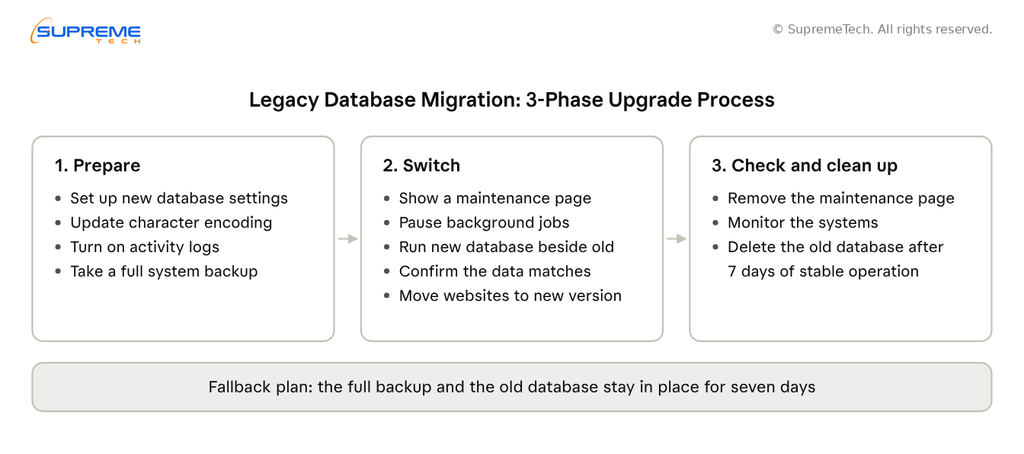
After the migration, the database version used by both systems reached the end of its vendor support. We upgraded it to a supported version with a simple method: build a copy of the database on the new version next to the old one, check that the data matches, then switch.
- Prepare: We set up the new database settings, updated the character encoding (how text is stored), turned on activity logs, and took a full backup of the system.
- Switch: We showed a maintenance page, paused scheduled background jobs, ran the new database alongside the old one, and confirmed that the data matched. Then we moved the websites to the new database.
- Check and clean up: We removed the maintenance page, monitored the systems, and deleted the old database only after seven days of stable operation.
The full backup and the old database stayed in place for seven days as a fallback plan in case any issue appeared.
How AI helped our team
We used AI tools to analyze the old code, support code updates, check configuration settings, and draft setup guides and step-by-step deployment plans (runbooks). This helped the team finish code reviews and documentation within a tight schedule. Our engineers handled every critical step themselves: switching the website addresses, setting up certificates, checking the data, testing the live websites and approving each release.
The Result
Both systems now run on AWS, with updated frameworks and a database version that is fully supported by its vendor.
- Security weaknesses fixed: The known security weaknesses in the CMS and customer inquiry forms were resolved.
- Active pages retained: Every active page remained available after the move.
- Customer data protected: Sensitive customer data was migrated in line with the security policy and PII guidelines.
- Lower server costs: Running costs dropped compared with the old local servers.
- One standard for website management: The websites are now managed under the global headquarters’ guidelines.
- Database upgrade with no data loss: 100% of the data was retained, the upgrade finished on schedule, and there were no unexpected disruptions outside the planned maintenance window.
The marketing websites went live on AWS in mid-March 2026. Our development work was completed on time, and the launch date followed the global headquarters’ own setup and configuration.
The client praised our smooth execution, clear communication and strong cloud expertise.
What’s Next?
Both systems continue to work with SupremeTech. We provide ongoing maintenance, infrastructure management, database maintenance and security monitoring. For the driving experience center’s portal, we have also started a new phase of feature development and user experience (UI/UX) improvements, which we will share in a separate case study.
Is this approach right for your business?
This approach fits companies that:
- Run several websites or portals on servers that are old or no longer maintained
- Use a CMS, framework or database version that no longer receives security updates
- Need to follow cloud or security rules set by a global headquarters
- Cannot take their websites offline for long
- Need to migrate sensitive customer data under strict security and PII rules
This is where our cloud migration & DevOps services come in. We plan the move, set up separate development, staging and production environments on AWS, update the code, and manage each switch with a clear runbook.
Are your websites still running on old servers or on software that no longer receives security updates? Talk to us about a legacy system modernization plan that keeps your services online. Explore our Cloud Infrastructure & DevOps services or contact us to discuss your project.
Tech Stack
AWS, Amazon EC2, PHP, Laravel, CakePHP, HTML, CSS, JavaScript

Tech Stack
Platforms
Infrastructure & Architect