










Cashback Innovations and Loyalty Trends 2026: What Retail Brands Should Watch
08/10/2026
9
The main cashback innovations and loyalty trends in 2026 all move value closer to the customer: rewards that arrive instantly, can be chosen freely, sit in a phone wallet, and may soon be redeemed by AI assistants. Each one raises the bar for accuracy behind the scenes. Retail brands should act now on real-time balances, clear reward terms and fraud controls, and watch AI-led redemption before investing heavily.
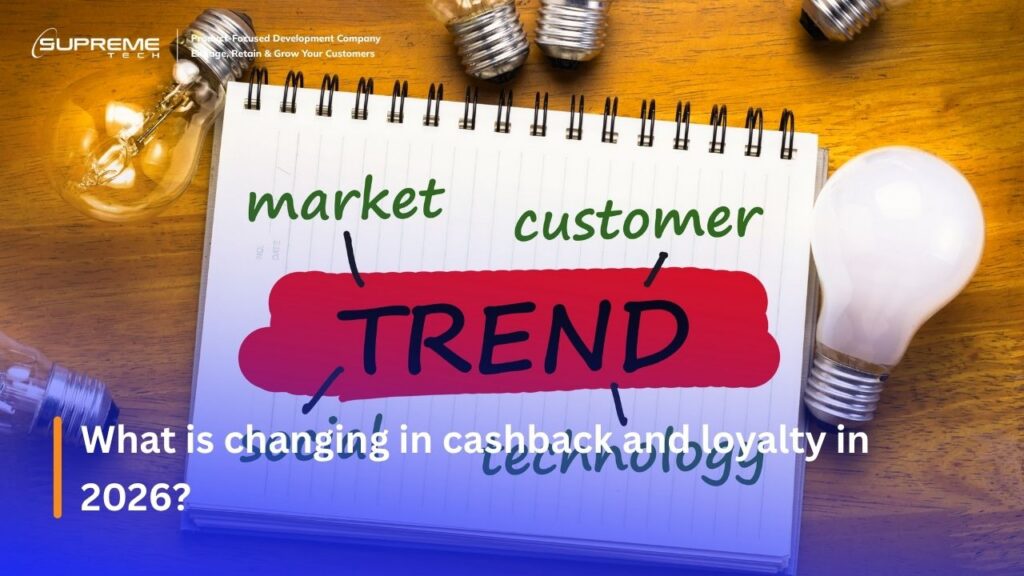
What is changing in cashback and loyalty in 2026?
The big change is control. Customers now expect to see their reward, choose how to use it, and use it soon. In Euromonitor International’s Top Five Trends in Loyalty for 2026, the research firm says brands are shifting toward simpler, more immediate and more relevant rewards. Its consumer survey also shows a gap between joining and using: only 19% of consumers redeem rewards weekly, while 28% redeem just a few times a year. Slow earning, poor visibility and points that expire before use are the main reasons it gives.
Cashback sits right in the middle of this shift. It is the easiest reward to understand, so it is also the easiest one for customers to judge. A late or wrong cashback credit feels less like a missed perk and more like a missing refund.
Read more:
5 cashback innovations and loyalty trends to watch in 2026
Each trend below has two parts: what is changing for customers, and what it demands from the systems that run your program.
1. Instant cashback replaces the “pending” period
Instant cashback means the credit lands at checkout or within minutes, not weeks later. Customers like it because the value feels real right away.
The catch is that the old waiting period was doing quiet work. It gave the retailer time to see returns, cancellations and failed payments before releasing any value. Remove the wait, and you need rules to take back cashback on items that come back.
Here is an illustrative example. Assume a retailer processes 100,000 cashback orders a month, with an average order of $60 and 2% cashback. That is $120,000 credited each month. If 10% of those orders are returned, about $12,000 a month in cashback must be reversed, often after the customer has already spent some of it. These figures are assumptions, not benchmarks, but the logic holds at any scale.
What it demands: a real-time reward ledger, reversal rules for full and partial returns, and a clear policy for balances that turn negative.
2. Cashback becomes one choice in a flexible reward wallet
Choice-based rewards let customers decide whether to take cash, points, a discount or a perk. Euromonitor names this as one of its five loyalty trends for 2026 and reports that 54% of consumers redeem benefits at least once a month. Personalization still has room to improve, though: in Deloitte’s 2024 Consumer Loyalty Survey, only 60% of consumers were satisfied with the personalized experiences they receive.
In practice, cashback is moving inside tiers and paid memberships instead of running as a separate campaign. A premium member might choose a higher cashback rate, while a casual shopper sticks with points.
What it demands: one value ledger for every reward type, with clear conversion rules, so the balance a customer sees in the app matches what the store and the website see.
Read more:
3. Rewards move into the mobile wallet
More brands are putting loyalty cards and balances into phone wallets instead of asking customers to download yet another app. Google’s Wallet developer documentation shows that brands can issue loyalty passes through the web, email or SMS, update them through an API, and trigger push notifications.
That is good news for redemption, because the balance is always one swipe away. It also means mistakes are one swipe away. If a return reverses cashback but the pass still shows the old balance, the customer spots the error before your support team does.
What it demands: event-driven updates, so every earn, spend and reversal reaches the wallet pass within minutes.
4. AI agents start redeeming rewards for shoppers
Euromonitor calls this trend “Loyalgentic”: AI tools that act for consumers, start engagement, redeem rewards and apply them automatically. It is early, but the direction is clear. A shopper may soon ask an assistant to use their best available reward and expect it to just work.
For most retailers, this is a trend to watch rather than fund. The useful preparation is the same work that helps human shoppers today: reward terms written as clear rules, a secure API for balances and redemption, and consent checks before anything is spent on a customer’s behalf.
What it demands: structured, machine-readable reward rules and an authorization step for redemptions an agent starts.
5. Cashback is treated like money, by regulators and fraudsters
Regulators already judge rewards on fairness. In May 2024, the US Consumer Financial Protection Bureau reported complaints that rewards were devalued after customers earned them, hidden behind vague conditions, or revoked when accounts closed. Its report focused on credit cards, but retailers that run their own cashback face the same customer expectations. In Australia, the ACCC’s final report on customer loyalty schemes called for reforms on how schemes communicate changes and handle customer data.
Fraudsters see the same value. In its July 2025 report on loyalty fraud, EY describes loyalty accounts as “soft digital wallets” and estimates that fraud takes 150 to 180 days to detect on average. Account takeover, fake orders that earn rewards before being canceled, and insider balance edits are common patterns.
What it demands: advance notice before any change to reward value, extra verification for high-value redemptions, alerts for unusual earning or spending, and audit logs for manual balance edits.
What Japan’s cashless rebate shows about cashback at scale
Japan offers a real-world lesson. Its government used point reward programs to move shoppers toward cashless payments, and Japan’s Ministry of Economy, Trade and Industry reports that the cashless payment ratio reached 32.5% in 2021. Researchers at the University of Tokyo found that credit card use rose at participating restaurants and stayed higher after the program ended in June 2020 (working paper).
The lesson for retail brands is that well-designed rewards can change habits that outlast the incentive. In Japan, points already feel like money to many shoppers, which is exactly why accuracy and trust matter so much.
Read more:
Which trends should retail brands act on now?
Act now on the trends that protect trust, and watch the ones that depend on outside platforms. The table below is our reading of 2026 priorities for a typical omnichannel retailer, so your order may differ depending on your channels and customers.
| Trend | What it asks of your systems | 2026 verdict |
| Instant cashback | Real-time ledger, return reversal rules | Act now if you already offer cashback |
| Flexible reward choice | One balance across cash, points and perks | Act now if you run tiers or paid membership; plan otherwise |
| Wallet passes | Event-driven balance updates | Pilot with one customer segment |
| AI agent redemption | Machine-readable terms, secure APIs, consent checks | Watch |
| Trust and fraud controls | Change notices, extra checks on redemption, anomaly alerts, audit logs | Act now |
A simple test helps here. If a customer returned an item today, would their cashback balance be correct on the website, in the app, at the till and in their wallet within the hour? If the answer is no, fix that before launching a richer offer.
How SupremeTech approaches cashback and loyalty platforms
SupremeTech’s work on a real loyalty project shows what these demands look like in practice. For a Japanese restaurant corporation operating in Japan, Taiwan, Malaysia and the United States, SupremeTech built a scalable loyalty points system on AWS. A central Point Gateway connects the mobile app, the POS system and external point services, so points are earned, used or canceled in real time at checkout. After launch in July 2024, the system handled up to 200,000 users every 30 minutes at peak, and 25 to 26% of diners used the new point service when paying.
That project was a points program rather than cashback. Still, the core needs are the same: real-time earning, reliable reversal and steady performance when traffic spikes.
Conclusion
Across the cashback innovations and loyalty trends 2026 has brought, one pattern stands out: customers get more speed and choice, and slow or inaccurate systems get exposed faster. Start with the basics: one accurate balance, clear rules for reversals and changes, and fraud monitoring that treats rewards like money. Then add instant credit, wallet passes and, later, AI agents on top.
If you want to check whether your loyalty platform is ready for instant or flexible cashback, talk to SupremeTech now.
Frequently Asked Questions
The main shifts are instant cashback at checkout, flexible reward choice, balances stored in phone wallets, AI agents that redeem rewards for shoppers, and stricter expectations around fairness and fraud. All of them move value closer to the customer and raise the bar for accuracy.
Instant cashback feels more valuable to customers because they can use it right away. It only works well when the retailer can reverse credit automatically on returns and cancellations, because the old waiting period no longer catches those cases.
Neither is better for every brand. Cashback is easier to understand, while points give more room for tiers and campaigns. Many retailers now offer both and let customers choose, which requires one shared balance behind the scenes.
Phone wallets let customers keep a loyalty card and balance without installing another app, and brands can update the pass and send notifications. The balance must update quickly after every earn, spend or reversal, or customers will see mistakes.
Add extra verification for high-value redemptions, set alerts for unusual earning or spending, limit manual balance edits and log them, and watch for orders that earn rewards and are then canceled. Treat reward balances with the same care as payments.