






DevOps Transformation: How CI/CD, IaC, and Monitoring Improve Retail Digital Product Delivery
07/07/2026
433
Retail digital product delivery gets harder when every new feature depends on several connected systems. A seasonal campaign may touch the mobile app, e-commerce checkout, loyalty logic, inventory visibility, payment flow, warehouse routing, and customer support dashboard at the same time. When delivery is still manual, a small release delay can quickly become a business problem.
This is why DevOps transformation matters for retail. It is not only a technical modernization project. It is a way to make product delivery less fragile when stores, apps, promotions, and customer expectations move faster than traditional release processes can handle.
The business stakes are visible in how major retailers invest in digital operations. Axios reported that Target planned to invest $100 million to expand sortation centers and speed up online order delivery, after seeing a 150% increase in next-day deliveries since launching its first center in 2020. That example is about fulfillment, but the same lesson applies to software: retail performance depends on how quickly operational systems can adapt.
This article explains how CI/CD, Infrastructure as Code, and monitoring improve retail digital product delivery in practical terms. It also shows where retail teams should start when they want better release speed without adding more operational risk.
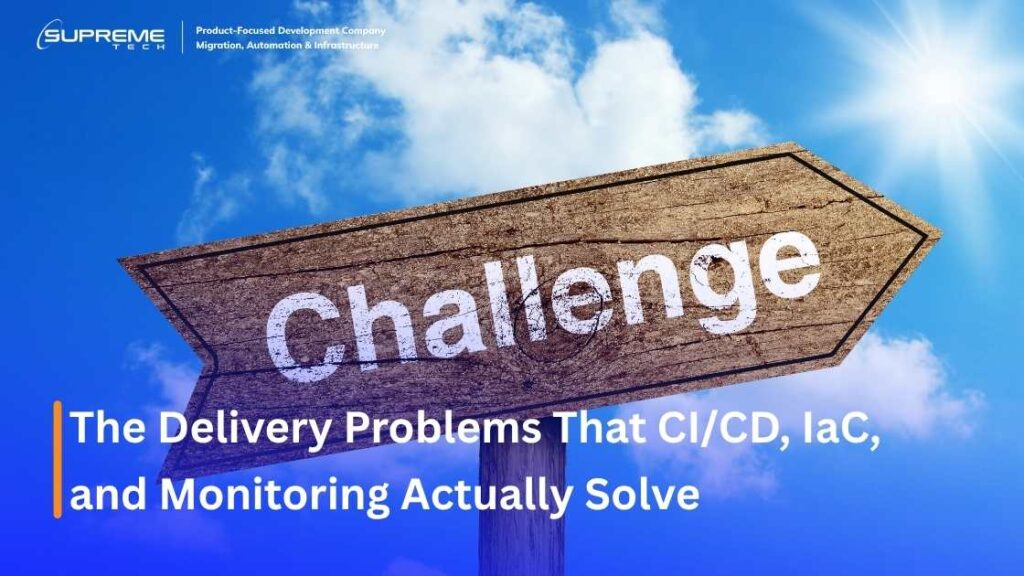
The Delivery Problems That CI/CD, IaC, and Monitoring Actually Solve
Most retail tech teams do not lack engineers or ideas. They lack a reliable way to ship changes quickly without breaking things that are already working.
Here is what that looks like in practice.
Shipping one change requires coordinating many teams
A “10% off for members” campaign is not one change. It touches front-end banners, promotion rules, loyalty eligibility, checkout validation, customer segmentation, analytics tags, and support scripts. When each team deploys on its own schedule and manually, the risk of something conflicting or breaking mid-campaign is high. This is the problem CI/CD solves, it automates how code moves from development to production, runs tests at every step, and gives teams a consistent, repeatable way to release without depending on manual handoffs.
Peak periods punish inconsistent environments
A release that works in staging breaks in production. A setting someone changed manually three weeks ago causes an outage during the Black Friday sale. Nobody can find what changed or when. This is the problem Infrastructure as Code solves when environments are defined in code rather than configured by hand, every setting is documented, versioned, and reproducible. There are no mystery changes. And rolling back is a git revert, not a guessing game.
Problems reach customers before the team knows about them
Traffic spikes. Checkout slows. Payment response times climb. Nobody notices until customers start complaining on social media. This is the problem Monitoring solves, it gives teams visibility into what production is actually doing after a release, so they can catch degradation early, set automatic alerts, and respond before customers experience the impact.
These three problems are connected. CI/CD, IaC, and Monitoring work together. The next sections explain how each one works in a retail context and what the combined result looks like.
What DevOps Transformation Actually Changes in Retail Teams
DevOps transformation changes how work moves from idea to production. Instead of treating development, infrastructure, QA, and operations as separate stages, it connects them into one delivery system with shared responsibility.
CI/CD makes release work repeatable
CI/CD turns build, test, and deployment steps into a consistent pipeline. Code changes are integrated frequently, tested automatically, and prepared for release through a defined path.
The benefit is not that every release becomes automatic overnight. The benefit is that releases stop depending on memory, spreadsheets, and last-minute coordination.
Infrastructure as Code makes environments predictable
Infrastructure as Code, often shortened to IaC, lets teams define infrastructure configuration in version-controlled files instead of relying on manual setup. In retail, this matters because staging environments, campaign environments, store integrations, and production checkout systems can drift quickly when changes are handled manually.
That warning matters for retail. IaC reduces manual drift, but it also needs code review, testing, and governance. A bad infrastructure change can affect checkout, inventory sync, or campaign performance just as seriously as a bad application release.
Monitoring makes production feedback visible
Monitoring connects engineering decisions to production reality. It shows whether a release increased checkout errors, slowed product search, broke loyalty redemption, or raised API latency between store and online systems. The National Institute of Standards and Technology explains in its log management guidance that effective log management supports analysis of system and application activity throughout an organization.
A practical view of the transformation
| Old delivery habit | DevOps transformation behavior | Retail outcome |
| Large release batches | Smaller changes released through a repeatable pipeline | Lower release anxiety before campaigns |
| Manual server or cloud changes | Infrastructure defined, reviewed, and versioned as code | Fewer hidden environment differences |
| Testing mainly before launch | Automated tests run throughout delivery | Earlier detection of checkout or loyalty defects |
| Monitoring after customers complain | Dashboards and alerts tied to key customer journeys | Faster response during sales peaks |
| Operations team receives late handoffs | Engineering and operations plan reliability together | Clearer ownership after release |
In a retail context, the table is not a maturity checklist. It is a practical way to see where delivery risk is hiding. The first place to modernize is usually the step that delays releases most often or creates the most customer-facing incidents.
How CI/CD Helps Retail Teams Release Faster With Less Risk
CI/CD improves retail delivery by reducing the size, uncertainty, and manual effort of releases. This is especially important when customer-facing systems need frequent updates but cannot afford frequent disruption.
Small changes reduce release-day pressure
A major reason retail releases become stressful is that too many changes wait for the same release window. When multiple features, fixes, and infrastructure changes move together, it becomes difficult to identify what caused a problem.
The practical goal is to keep each release small enough to understand, test, and recover. For retail, this can mean releasing a search improvement separately from a checkout change instead of bundling them into one risky launch.
Automated tests protect the revenue path
Retail teams should not automate every possible test before seeing value. They should start with the revenue path: product discovery, cart, checkout, payment, loyalty redemption, order confirmation, and key customer account actions.
Safer rollouts help teams respond during active campaigns
Retail product teams often need to adjust campaigns while they are live. A promotion may need a copy change, a loyalty rule may need refinement, or a mobile app experience may need a quick fix after feedback from stores.
With a healthier CI/CD process, those adjustments do not need to wait for a large release ceremony. They can move through tests, approvals, and controlled rollout steps in a more predictable way.
Brand Case Study: Target
Target shows how retail performance depends on the ability to connect digital operations with physical execution. Axios reported that Target planned a $100 million investment to expand sortation centers by opening six more centers by the end of 2026, and said the retailer had seen a 150% increase in next-day deliveries since launching its first sortation center in 2020. The software lesson is clear: when digital fulfillment becomes a core customer promise, product delivery and operational systems must be able to change without chaos.
How Infrastructure as Code Makes Retail Environments More Reliable
IaC improves reliability by making infrastructure changes visible, repeatable, and reviewable. That matters because retail environments multiply quickly as brands add channels, regions, stores, and customer-facing applications.
Retail environments multiply faster than teams expect
A growing retail brand may have development, staging, production, regional test environments, partner integrations, data pipelines, and store-specific configurations. If these environments are created manually, hidden differences appear over time.
Those differences create classic retail problems: a promotion works in staging but fails in production, a payment provider behaves differently in one region, or a store inventory integration cannot be reproduced by the engineering team.
Version-controlled infrastructure reduces hidden differences
IaC does not remove the need for judgment. It gives teams a better way to see, review, and reproduce infrastructure decisions.
When infrastructure is managed as code, a database setting, network rule, scaling parameter, or service configuration can be reviewed before it changes production. That creates a clearer trail of why an environment changed and who approved it.
IaC needs quality controls too
IaC can create risk when teams treat infrastructure changes as simple automation instead of production code. Retail teams should review infrastructure definitions the same way they review application code, because one configuration mistake can affect availability, security, or performance.
For retail teams, that means IaC should be reviewed with the same seriousness as application code. A misconfigured caching rule or access policy can affect customer experience, security posture, and incident recovery.
What this means for retail technology leaders
The business value of IaC is not “more automation” in the abstract. There are fewer unknowns when the business is trying to move quickly.
If a retail brand is opening a new market, launching a new commerce experience, or preparing for a traffic-heavy campaign, IaC helps the engineering team reproduce the right environment instead of rebuilding it from memory.
Why Monitoring Matters After Every Retail Release
Monitoring turns release management into an active feedback loop. Without it, teams may know that a deployment completed, but not whether customers can browse, buy, redeem, or receive updates normally.
Monitoring connects code changes to customer behavior
A release is not successful simply because the deployment tool says it finished. In retail, success means customers can still search products, add to cart, complete payment, redeem benefits, receive order confirmation, and get accurate inventory information.
That is why monitoring should be aligned with business journeys, not only server health. Teams need to see technical signals and customer journey signals together.
Good dashboards separate product issues from infrastructure issues
When a checkout conversion drop appears after release, the cause may be front-end code, payment latency, promotion logic, third-party response time, inventory sync, or a data pipeline delay. A useful monitoring setup helps the team narrow the investigation quickly.
Incident reviews should improve the next release
Monitoring becomes most valuable when teams use it after incidents. A post-release issue should answer concrete questions: What changed? What signal appeared first? Why did the alert trigger late? What test should be added? What runbook was missing?
This is how DevOps transformation becomes continuous improvement rather than a one-time tooling project. Each incident should make the next release safer.
Monitoring should be understandable outside engineering
Retail product managers, operations leaders, and customer support teams do not need every technical metric. They need shared visibility into customer-impacting conditions.
For example, a dashboard showing checkout error rate, product search latency, payment success rate, and order confirmation delay is more useful during a campaign than a long list of low-level system metrics without business context.
Where Retail Teams Should Start Their DevOps Transformation

A DevOps transformation should start where release friction is already hurting the business. Retail teams do not need to modernize everything at once. They need to pick the delivery constraint that creates the clearest operational or customer risk.
Start with the most painful release bottleneck
Some teams struggle because QA takes too long. Some struggle because environments are inconsistent. Others struggle because production issues are invisible until store teams or customers report them.
The first DevOps investment should match the actual bottleneck. CI/CD helps when releases are slow and manual. IaC helps when environments drift. Monitoring helps when teams cannot detect or diagnose production problems quickly.
Protect the revenue path before optimizing everything else
Retail teams should prioritize systems that directly affect revenue and trust. That usually includes checkout, payment, account login, loyalty, inventory visibility, order status, and critical campaign logic.
This keeps DevOps work commercial. Instead of saying “we need a pipeline,” the team says “we need to release checkout fixes safely before a campaign.” That framing makes the modernization easier to justify.
Modernize gradually, but make the standards visible
A natural transformation path is to start with one product area, one pipeline, one environment standard, and one monitoring dashboard tied to business impact. Once that pattern works, the team can repeat it across more systems.
The mistake is trying to redesign every tool, team, and process at once. Retail delivery improves faster when the first success creates a reusable pattern.
Use a simple decision table before investing
| Symptom | Likely delivery problem | Best first move |
| Releases are delayed by manual approval and handoffs | CI/CD process is immature or inconsistent | Map the release path and automate build, test, and deployment steps |
| Features behave differently in staging and production | Environment drift is affecting quality | Introduce IaC for the most business-critical environment |
| Incidents are discovered by customers first | Monitoring is not connected to customer journeys | Create release dashboards for checkout, search, payment, and loyalty |
| Teams avoid small fixes during campaigns | Rollback and rollout confidence is low | Introduce safer release patterns and operational runbooks |
| Engineering and operations argue after incidents | Ownership is unclear after deployment | Define shared release ownership and review incidents together |
How SupremeTech Can Help
A typical conversation with SupremeTech does not start with “Which DevOps tools should we install?” It starts with a more useful question: Where does digital product delivery currently slow down, break, or create risk for the business?
The work starts with a delivery diagnostic
For a retail brand, that diagnostic often follows one customer journey from idea to production. The team looks at how a change moves within your organization and existing systems.
This usually reveals the real constraint. Sometimes the problem is not the engineering team. It is a release process that depends on manual approvals, a staging environment that no longer mirrors production, or monitoring that is too technical for product and operations teams to act on.
Then the delivery foundation is improved step by step
When the issue is release flow, SupremeTech can help design CI/CD practices through its Cloud Infrastructure & DevOps capability. When the issue is customer-facing commerce complexity, the work may connect with E-commerce Development, especially when checkout, inventory, loyalty, and store operations need to move together.
For teams dealing with legacy systems or custom workflows, SupremeTech’s Custom Software Development experience helps modernize the parts of the architecture that block repeatable delivery. If AI-assisted testing, anomaly detection, or engineering acceleration is relevant, the team can also bring in AI-Driven Development in a controlled way, focused on delivery quality rather than hype.
The goal is stable delivery, not tool accumulation
SupremeTech’s approach is practical: improve the release path, reduce environment uncertainty, and make production behavior easier to understand. The goal is not to add more tools to an already fragmented stack. The goal is to help teams deliver retail digital products with more confidence.
If your retail team is preparing for faster product releases, omnichannel growth, or modernization of cloud delivery, start with a diagnostic conversation with SupremeTech. Contact SupremeTech here.
FAQs Section
DevOps transformation in retail is the process of improving how digital products are built, released, operated, and monitored across customer-facing systems. It connects development, operations, QA, infrastructure, and product teams around a shared delivery system. In practice, this helps retail teams release changes to apps, websites, loyalty systems, inventory services, and checkout flows with less manual risk.
The cost is usually felt through slow releases, avoidable incidents, missed campaign windows, and poor customer experience during peak periods. Retail teams may spend more time coordinating releases than improving products. Over time, slow delivery also makes the business less responsive to pricing changes, customer behavior, and competitive moves.
The right starting point depends on the main bottleneck. If releases are slow and manual, start with CI/CD. If environments behave differently, start with IaC. If teams discover problems too late, start with monitoring tied to customer journeys. Most retailers eventually need all three, but the first investment should solve the most painful delivery risk.
Useful measures include release frequency, lead time from change to production, rollback time, incident detection time, defect escape rate, and business journey metrics such as checkout error rate or search latency. The strongest ROI story connects engineering metrics to commercial outcomes. For example, faster recovery during a checkout incident is more meaningful than a generic increase in deployment count.
SupremeTech starts with the delivery problem, not the tool list. The team looks at how product changes move through the business and where risk appears. From there, the work may involve CI/CD design, cloud infrastructure improvement, e-commerce modernization, or custom software changes. The goal is to create a delivery system that fits the client’s operating model.