














Data Governance in Cloud: How to Manage Customer Data Quality, Access Control, and Compliance
11/06/2026
644
Scaling customer data in the cloud without a governance framework is the data equivalent of building a warehouse with no inventory system. The data is there. It is just impossible to trust, control, or use responsibly.
Most retail brands discover this at a specific, uncomfortable moment. A personalization campaign produces recommendations so obviously wrong that customers notice and complain. A regulator requests a data audit and nobody can produce one. A data breach surfaces records that should have been deleted months ago but were not, because nobody owned the deletion process.
These are not rare edge cases. They are predictable consequences of scaling data infrastructure without the governance layer that makes it manageable. Gartner research found that poor data quality costs organizations an average of $12.9 million per year. MIT Sloan Management Review, in collaboration with Cork University Business School, found that companies lose 15 to 25% of revenue annually due to poor data quality. The global data governance market reflects how seriously organizations are now taking this: valued at USD 4.15 billion in 2024 and projected to reach USD 23.13 billion by 2033 at a 21% CAGR, according to Straits Research. Cloud deployments already account for 72% of all governance installations, according to Mordor Intelligence.
This article explains what data governance in cloud actually requires, what it costs when it is absent, and how retail brands should approach building the three interconnected capabilities that make a cloud data platform something the business can rely on.
What Data Governance in Cloud Actually Covers
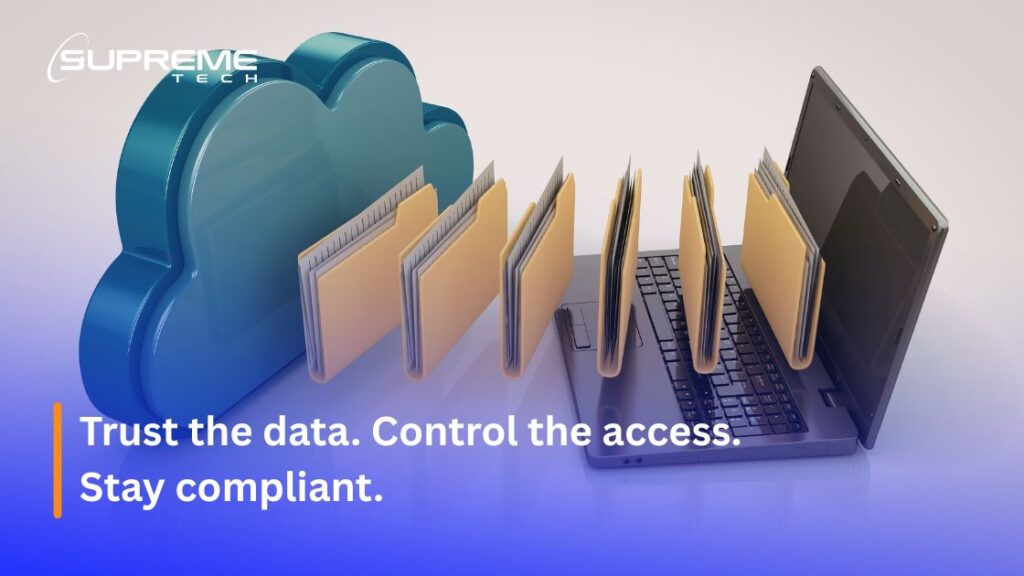
Data governance in the cloud is not a single tool and not a compliance checkbox. It is the organizational and technical framework that determines whether the data a retail brand collects and stores can be trusted, controlled, and used legally.
It covers three things, and the important word is “covers” rather than “consists of three separate programs,” because these three things are deeply connected and only work when they operate together.
The first is data quality: ensuring that the customer records, transaction logs, behavioral signals, and engagement data in the cloud platform are accurate, complete, consistent, and current. A loyalty member who exists under three different email addresses across three systems, with a purchase history that is partially duplicated and partially missing, is not a customer record. It is noise. And the personalization models, churn prediction scores, and loyalty analytics running on top of that noise will produce output that looks confident and is quietly wrong.
The second is access control: defining precisely which teams, systems, and individuals can see which data, at what level of detail, and for what purposes. A customer service agent needs to see a customer’s loyalty history and recent order status. They do not need to see that customer’s raw behavioral browsing data or full payment card details. Governance establishes who gets access to what, prevents overreach, and creates the audit trail that proves the controls exist and are working.
The third is compliance: meeting the legal obligations that govern how customer data is collected, retained, processed, and eventually deleted. GDPR in Europe, CCPA in California, PDPA across Southeast Asia, and equivalent regulations in most markets where retail brands operate all impose specific requirements. Non-compliance is not a theoretical risk. It has a documented and very specific financial cost, which the cases below make clear.
These three areas are not sequential. A brand that invests heavily in data quality without access controls ends up with clean, accurate data that can be misused or accessed inappropriately. A brand that implements access controls without compliance governance ends up with well-controlled data that is retained past its legal limit. A brand that focuses only on compliance without data quality ends up applying policies to records that cannot be trusted. All three need to move forward together.
When Governance Is Absent: What the Evidence Actually Looks Like

The clearest way to understand why data governance in cloud matters is to look at what happens in documented cases when it is missing.
Between 2014 and 2020, Marriott International experienced three separate data breaches that collectively affected more than 344 million customers worldwide. The breaches exposed passport information, payment card numbers, loyalty account details, dates of birth, and email addresses. The FTC’s administrative complaint identified the root cause not as a sophisticated external attack, but as a failure to implement reasonable data governance practices: inadequate password controls, insufficient network monitoring, and a failure to properly govern data access during the integration of Starwood Hotels’ systems following Marriott’s 2016 acquisition.
In October 2024, Marriott agreed to a $52 million settlement with 49 state attorneys general, alongside a parallel FTC settlement, as reported by Fortune. The financial penalty was significant. The attached conditions were arguably more consequential: a mandatory comprehensive information security program, enforced data deletion protocols, and independent third-party security assessments every two years for the next 20 years. Poor governance during a system integration turned a standard acquisition into a two-decade oversight obligation.
The enforcement trend extends well beyond hospitality and technology. Austrian food retailer REWE International was fined $9 million for collecting customer data without a valid legal basis, as cited in Netguru’s retail data privacy report. This is a grocery retailer, not a technology company. The common assumption that GDPR enforcement is primarily directed at big tech is not supported by the enforcement record. Cumulative GDPR fines reached approximately €5.88 billion by January 2025, according to Data Privacy Manager, and the enforcement net covers retail, hospitality, and e-commerce at scale.
Both Marriott and REWE share the same underlying failure pattern: customer data was collected and held without adequate controls over how it was stored, who could access it, how long it was retained, and whether the legal basis for its collection was documented and maintained. Neither failure required a sophisticated attack. Both required only an absence of governance.
Under GDPR, penalties can reach €20 million or 4% of annual global turnover, whichever is higher. For any retail brand operating across multiple markets, the cost of a single compliance failure can exceed the total investment in a well-designed governance framework many times over.
Read related articles:
- Cloud Data Platform: Why Retail Brands Need One Before Scaling Customer Data
- How Edge Computing for Retail Improves Store Performance
- Customer Loyalty Program App: What Features Retail Brands Need?
Getting Your Data Right: Why Quality Is the Foundation
Before compliance and access control can do their jobs, the data itself needs to be accurate, complete, and trustworthy. This sounds like a basic requirement, but it is the one most commonly skipped in the rush to scale a cloud data platform.
The specific failure modes that poor data quality produces in retail loyalty programs are predictable and expensive. Duplicate customer records, where the same person exists under multiple email addresses or identifiers across different systems, make CLV calculations unreliable, churn models inaccurate, and personalization recommendations incoherent. A customer who is a loyal buyer of your premium skincare line but whose records are split across a pre-migration database and a new CRM will be treated by your AI models as two different people, neither of whom looks particularly loyal.
Incomplete behavioral data, where events from certain channels fail to log correctly or are dropped during pipeline processing, creates systematic blind spots. The personalization model is working from a partial picture, but it does not know the picture is partial. It just produces weaker recommendations with equal confidence. Stale data, where contact preferences and consent records are not validated and updated over time, makes communication irrelevant and, in some cases, constitutes a compliance violation under data minimization requirements.
Gartner predicts that through 2026, organizations will abandon 60% of AI projects unsupported by AI-ready data. For retail brands investing in churn prediction models and personalization engines, this is the most commercially specific warning available: the AI is only as good as the data underneath it.
Fixing this requires four things to work consistently. Every data source feeding the cloud platform needs validation at the ingestion layer, not downstream after bad records have already propagated into the warehouse. The same customer needs to be identified as the same customer across every system, which means a systematic identity resolution process with clear rules about what constitutes a match and who owns disputed cases. The quality of the data needs to be measured and monitored continuously, so that a sudden drop in the completeness of mobile app behavioral data surfaces as an alert rather than a quiet blind spot that distorts the next quarter’s loyalty analytics. And someone specific needs to own each data domain and be accountable for quality metrics, with the authority to require remediation when anomalies appear.
In practice, a retail brand that runs NPS surveys across its loyalty program but stores the results in a marketing automation tool that never syncs to the loyalty data warehouse is effectively collecting evidence it cannot use. Governance ensures the data exists, is clean, and is in the right place for the teams that need it.
Who Can See What: Access Control as a Commercial and Legal Discipline
Access control in a cloud data platform is commonly treated as a security practice. It is more accurately understood as a governance practice, and the distinction matters because it changes who is responsible for it and what “good” looks like.
The commercial and legal principle underlying access control governance is data minimization: every user, team, and system should have access to the smallest amount of data necessary to do their specific job, and no more. A marketing analyst building loyalty campaign segments needs access to anonymized behavioral cohorts. They do not need access to raw individual transaction records with payment details. A loyalty platform engineer needs to see loyalty event logs. They do not need access to the customer service complaint history. The principle sounds straightforward. Actually implementing it across a cloud data platform used by dozens of teams requires deliberate design.
Role-based access control, implemented at the data warehouse layer, is the primary mechanism. What makes it governance rather than just security is the policy infrastructure around it: who decides which roles exist, who reviews and approves access requests, how access is revoked when someone changes roles or leaves the organization, and how the system handles edge cases. Without those policies and the processes to enforce them, RBAC becomes a set of permissions that reflect the organizational structure from when the platform was first built rather than the current reality of who needs what.
The audit trail is what gives access control its compliance value. Every query, every export, and every modification to customer data should be logged with a timestamp, a user identity, and a purpose identifier. This log serves three interconnected purposes. When something goes wrong, it enables retrospective investigation. When a regulator asks for evidence of appropriate data handling, it provides documentation the organization can actually produce. And over time, the existence of a comprehensive audit log shapes behavior within the organization: teams handle data more carefully when they know their access is recorded.
The point worth emphasizing is that access control governance is not just protection against external threats. Marriott’s three breaches were partly a consequence of inadequate access governance during a system integration, where data that should have been protected was accessible in ways that should not have been permitted. The organization did not have the controls to limit internal access appropriately, and the breach exploited that gap. Under GDPR and similar regulations, failing to demonstrate reasonable steps to protect customer data is itself a violation, independent of whether a breach occurred.
A data steward, a named individual accountable for a specific data domain, is the human layer that makes the technical access controls effective in practice. Without stewardship, access control policies exist on paper but are not consistently applied, exceptions accumulate, and the governance framework degrades.
Staying on the Right Side of the Law: Compliance in Practice
Compliance governance connects the technical infrastructure of a cloud data platform to the legal obligations that now apply to virtually every retail brand operating across more than one market. This is the area where most brands discover the largest gaps when they first audit their governance posture, because the requirements are specific and the consequences of non-compliance are documented and severe.
The starting point is a data inventory: a complete, current map of every category of customer data collected, where it is stored, the legal basis for its collection, and the regulatory obligations that apply to it. This sounds like paperwork. In practice, it is the foundation document that regulators request first and that most organizations discover they do not have in usable form until they need it urgently. Building it requires going beyond the customer-facing systems to include every data store in the cloud architecture: the data warehouse, the analytics environment, the backup systems, and any data shared with third parties.
Consent management sits on top of that inventory. This is the technical and process framework that records the specific legal basis under which each category of customer data was collected, maintains that record as customers update their preferences or withdraw consent, and enables the organization to honor data rights requests: the right to access, the right to correct, the right to delete, and the right to portability. In a cloud data platform, consent management needs to be integrated at the ingestion layer. Data collected without a documented legal basis should be flagged before it enters the warehouse, not audited retrospectively when a data subject rights request arrives.
Retention and deletion schedules are the operational requirements that most organizations handle the worst. Regulations require that personal data is not kept beyond the period necessary for the purpose for which it was collected. In practice, data accumulates indefinitely in cloud platforms because deletion is effortful and nobody specifically owns the process of ensuring it happens. A customer who opts out of a loyalty program does not just need to be removed from the active member list. Their personal data needs to be deleted from the cloud data warehouse, the marketing automation platform, the customer service CRM, any analytics environments where their records are stored, and any third-party data sharing arrangements. Governance is what makes that deletion comprehensive rather than partial and verifiable rather than assumed.
Third-party data sharing governance closes the loop. Retail brands that share customer data with analytics providers, marketing platforms, or partner networks for personalization purposes need clear controls over what is shared, with whom, under what contractual terms, how long the recipient can retain it, and what happens to it when the relationship ends. This was a specific failure identified in the Marriott case: inadequate oversight of vendor and franchisee data access contributed directly to the breach exposure.
| Compliance Risk | What Usually Causes It | What Governance Needs to Do |
|---|---|---|
| Data retained beyond permissible period | No automated retention schedules; manual process never enforced | Retention policy automated at the data warehouse layer |
| Data collected without valid legal basis | No consent management at ingestion | Consent record linked to every data collection event |
| Unauthorized access to personal data | Overly permissive access policies; no audit logging | RBAC policy with comprehensive audit trail |
| Breach during system integration | No access governance across integrated systems | Integration governance checklist and security assessment before go-live |
| Incomplete data subject rights fulfillment | No unified data inventory | Data map covering all systems where personal data is held |
Why Good Governance Enables Commercial Ambition Rather Than Limiting It
The most common internal objection to data governance investment is that it slows things down: that access controls reduce analyst productivity, that compliance requirements prevent the brand from using customer data in commercially valuable ways, and that governance is overhead the business cannot afford while it is still scaling.
This framing gets the causal relationship backwards. Data governance does not limit what a retail brand can do with customer data. It determines whether the brand can actually trust what the data is telling it, and whether the capabilities being built on top of that data will hold up over time.
A loyalty analytics program running on unvalidated, duplicate-ridden customer records produces churn scores that identify the wrong customers as at-risk. The interventions triggered by those scores waste budget and fail to reach the customers who actually need them. A personalization engine that ingests behavioral data without consent controls creates legal exposure that can shut the program down entirely. An AI model trained on poor-quality, ungoverned data produces recommendations that erode customer trust faster than any discount can rebuild it.
Gartner predicts that 80% of data governance initiatives will fail by 2027 without a crisis catalyst, and that companies failing compliance audits experience a 31% data breach rate compared to only 3% among compliant organizations. The commercial case is direct: governance built into the platform before it scales costs a fraction of governance retrofitted after a breach or a compliance failure has forced the issue.
MIT Sloan Management Review and Cork University Business School found that companies implementing robust data quality frameworks can recover significant portions of the 15 to 25% of annual revenue currently lost to poor data quality. That recovery does not require new data sources or new analytics capabilities. It requires governing the data the brand already has.
How SupremeTech Can Help
When retail brands come to SupremeTech with data governance challenges, the presenting problem is rarely described as a governance issue. It is described as a loyalty analytics problem, a compliance audit the team is not prepared for, or a personalization program that is producing output nobody trusts. When we look at the underlying architecture, the pattern is almost always the same: data that should be unified is not, access controls that should exist do not, and regulatory obligations are being met partially or retrospectively rather than systematically.
For brands building or rebuilding their cloud data architecture, SupremeTech’s cloud infrastructure and DevOps practice designs governance into the platform from the start.
For brands operating across markets with different regulatory regimes, SupremeTech’s custom software development team builds the consent management and data rights fulfillment capabilities that handle those obligations at the architecture level rather than through manual processes that do not scale as the customer base grows.
For brands that have governance policies in place but lack the automated systems that enforce them, SupremeTech’s AI-driven development team builds the data quality monitoring, anomaly detection, and automated remediation workflows that turn a governance document into an operating system.
Ready to build data governance that enables your commercial programs rather than constraining them? SupremeTech helps retail brands design and implement cloud data governance across quality, access control, and compliance, built into the platform from the start.
Start a conversation with SupremeTech →
FAQs Section
Data governance in cloud applies the same core principles as on-premise governance but must adapt to the specific characteristics of cloud infrastructure. Cloud environments are inherently more dynamic: pipelines can be spun up quickly, new data sources can be integrated without IT intervention, and data can be shared across teams with much lower friction than on-premise architectures allowed. This speed and flexibility creates governance challenges that do not exist in the same form on-premise. Access controls need to apply to cloud-native query environments. Audit logs need to capture activity across distributed services. Retention schedules need to account for data replicated across multiple cloud regions. On-premise governance tools and policies often need to be redesigned rather than simply migrated to work effectively in a cloud environment.
The most widespread failure is unresolved duplicate customer records created during system migrations or integrations, leaving the brand with a fragmented view of its customer base. The second is overly permissive data access: large teams given broad access to raw personal data they do not actually need for their work, creating both breach exposure and compliance risk. The third is data retained well beyond its permissible period because no automated retention schedules were ever implemented, meaning data that should have been deleted years ago is still sitting in the warehouse when a regulator or breach investigator looks for it. All three are preventable with governance designed before the platform scales rather than retrofitted afterward.
Directly and significantly. AI models are only as reliable as the data they are trained on. Gartner predicts that through 2026, organizations will abandon 60% of AI projects unsupported by AI-ready data. For retail brands building churn prediction models and personalization engines, data governance is the prerequisite that determines whether those investments produce the intended outcomes. A churn model trained on data with a 30% duplicate rate will misidentify at-risk customers consistently. A recommendation engine trained on behavioral data missing events from certain channels will underperform specifically for customers who use those channels. Governance is not separate from the AI strategy. It is what the AI strategy depends on.
Customer trust is increasingly a direct function of how brands manage the personal data customers share. Research cited by Netguru found that 26% of consumers abandoned a brand in the past year due to privacy concerns, and only 8% of consumers felt comfortable sharing personal details with online vendors in 2024, down from 20% in 2022. Data governance is what allows a brand to make credible, verifiable commitments about how customer data is handled: how long it is kept, who can see it, what it is used for, and what happens when a customer asks for it to be deleted. Brands that govern data well can keep those commitments. Brands that do not are making promises they cannot verify or fulfill.
The sequencing depends on where the most urgent exposure is. For brands primarily concerned about the accuracy of loyalty analytics and personalization quality, data quality is the immediate priority: identity resolution, validation at ingestion, and data monitoring. For brands expanding into markets with new regulatory obligations, compliance is the immediate priority: data inventory, consent management, and retention schedules. For brands preparing for a regulatory audit or recovering from a security incident, access control and audit logging come first. In most cases, a governance audit at the start surfaces a small number of specific gaps with the highest immediate impact, which makes sequencing decisions concrete rather than theoretical.