








How Edge Computing for Retail Improves Store Performance
10/06/2026
690
Edge computing for retail matters because store performance now depends on how quickly a brand can sense, decide, and act inside each physical location.
Retail leaders are not short on data. They are short on usable, timely signals. A store may already collect checkout activity, shelf movement, inventory changes, mobile app events, camera feeds, order pickup requests, and loyalty interactions. The problem is that many of these signals still travel through slow, disconnected, or cloud-only workflows before store teams can act.
That delay shows up in ways customers immediately notice. A product appears available online but cannot be found on the shelf. A queue grows while staff are unaware of the bottleneck. A promotion reaches a customer after they leave the store. A payment or loyalty transaction depends too heavily on network stability.
The stakes are commercial, not just technical. According to Deloitte research published by The Wall Street Journal, 80% of B2C leaders believe consumers are impressed by their online shopping experiences, while fewer than half of consumers agree. The same research found that consumers spend 37% more with brands that deliver consistent and positive commerce interactions.
For retail brands, that means infrastructure has become part of customer experience. If the store cannot respond in real time, it becomes harder to protect conversion, inventory accuracy, associate productivity, and customer trust.
This article explains how edge computing for retail works, which store problems it solves first, how to decide between cloud and edge architecture, and how retailers can build a practical store-performance roadmap without overengineering the first phase.
What Edge Computing for Retail Changes Inside the Store
It Moves Decisions Closer to Store Events
The main value of edge computing for retail is simple: it moves selected computing tasks closer to where store events happen.
Instead of sending every event to a centralized cloud first, an edge layer can process time-sensitive signals locally. That edge layer may sit on an in-store server, store controller, gateway, smart camera system, local network appliance, or lightweight computing node. The goal is not to replace cloud systems. The goal is to let urgent store workflows continue without waiting for distant infrastructure.
The National Institute of Standards and Technology describes fog computing as a layered model that supports distributed, latency-aware applications through nodes between smart end devices and centralized services. For retailers, that concept translates into store systems that can process local events before syncing broader records back to central systems.
It Reduces Dependency on Always-On Cloud Connectivity
Retail operations do not stop when a connection becomes unstable. Checkout, loyalty redemption, shelf alerts, inventory lookups, and order pickup flows still need to work while customers are standing in the store.
Edge infrastructure gives retailers a practical way to keep critical workflows responsive during network congestion or temporary service interruption. Store teams can continue operating locally, then sync data when connectivity stabilizes.
For example, a restaurant chain with app payment, loyalty redemption, and POS integration cannot afford delayed point updates during lunch rush. A fashion retailer running ship-from-store workflows cannot wait several minutes to confirm whether a size is physically available in a specific branch.
It Turns Store Infrastructure Into an Operational Layer
A store used to be treated mainly as a sales location. Modern stores behave more like distributed operating nodes. They fulfill online orders, support loyalty journeys, host returns, personalize offers, coordinate staff tasks, and collect large amounts of operational data.
Edge computing for retail makes this shift manageable. It allows the store to make immediate decisions locally while still participating in a larger digital ecosystem.
This is especially important for retailers with many branches. When every location depends entirely on central systems, one bottleneck can affect many stores at once. When stores have local processing capability, critical workflows can be isolated, prioritized, and recovered more safely.
In Practice
A grocery store can use edge processing to detect a growing checkout queue and alert nearby staff before the queue becomes a customer complaint. A restaurant chain can process loyalty-point use at the POS instantly, then sync the transaction later with the central customer system. The customer sees speed, while the business sees cleaner operational control.
Which Store Performance Problems Edge Computing for Retail Solves First
Checkout and Payment Bottlenecks
Checkout is often the first place where slow infrastructure becomes visible. Customers may tolerate a short wait, but they quickly lose patience when systems freeze, receipt checks slow exits, or payment confirmation takes too long.
Edge computing can support checkout performance by allowing selected validation steps to happen near the transaction. This can include barcode validation, payment-state checks, cart verification, loyalty calculation, offline transaction buffering, and queue monitoring.
The point is not to automate every checkout interaction. The point is to reduce the delay between a customer action and the system response that confirms it.
Inventory Accuracy and Stockout Response
Inventory accuracy is one of the strongest commercial reasons to consider edge infrastructure. Retailers may know what the system thinks is available, but the store floor often tells a different story.
When shelf data, POS data, fulfillment data, and associate tasks update too slowly, customers experience phantom inventory. The product appears available, but staff cannot find it. The outcome is lost trust and missed revenue.
Edge computing helps by supporting faster local detection. A store can identify shelf gaps, misplaced items, pickup order exceptions, or stockroom movements before the central system catches up.
Associate Productivity
Store associates lose time when systems do not tell them what to do next. They search manually for products, respond late to queues, check multiple systems for order status, or repeat inventory checks that should have been automated.
A well-designed edge layer can convert store events into immediate tasks. Instead of waiting for a manager to interpret reports, associates can receive prioritized actions, such as restock this shelf, open another checkout lane, verify this pickup order, or check this product location.
This matters because store teams are often the final link between digital promise and physical execution. Better infrastructure should reduce manual checking, not add another dashboard.
Customer Experience Personalization
Personalization inside the store is harder than personalization online because timing is tighter. A website can recommend products while a customer scrolls. A physical store must respond while the shopper is moving through aisles, scanning a membership code, checking out, or asking an associate for help.
Edge computing for retail can support location-aware offers, loyalty recognition, assisted selling, and real-time customer service triggers when the data is processed responsibly and with clear consent.
The practical value is relevance. A loyalty member who just scanned an app at the entrance does not need a generic campaign tomorrow. They may need a useful reminder, product suggestion, or service support while they are still in the store.
Comparison Table: Store Problems and Edge Impact
| Store problem | Cloud-only risk | Edge-enabled improvement |
| Checkout delay | Validation depends on remote response time | Selected checks happen locally before central sync |
| Shelf gaps | Out-of-stock signals arrive late | Shelf and inventory events trigger faster staff action |
| Pickup order exceptions | Store teams discover issues after customer arrival | Local availability and task alerts update earlier |
| Queue growth | Managers react after visible congestion | Local event detection alerts staff sooner |
| Personalization timing | Offers arrive after the store visit | Contextual triggers can happen during the visit |
In Practice
A fashion retailer should not start edge transformation by trying to process every store event locally. It can begin with one high-value workflow, such as improving inventory confidence for click-and-collect orders. Once that works, the same architecture can support returns, loyalty recognition, and associate tasking.
What an Edge-Ready Retail Infrastructure Should Include
The STORE Edge Stack Framework
Key Concept: The STORE Edge Stack helps retail teams evaluate whether their store infrastructure is ready for real-time operations. STORE stands for Signals, Throughput, Orchestration, Resilience, and Experience. If one layer is weak, the store may collect data without turning it into operational improvement.
S: Signals From Store Systems
Signals are the raw events that come from the store environment. They may include POS transactions, shelf activity, camera events, RFID reads, mobile app scans, loyalty identification, stockroom movement, temperature sensors, payment events, or order pickup changes.
The first infrastructure question is not whether the store has enough technology. It is whether the right signals are being captured accurately and consistently.
For example, an apparel retailer may need item-level product movement signals, while a convenience store may care more about checkout, queue, and replenishment signals. The architecture should follow the operating model, not the other way around.
T: Throughput for Real-Time Workloads
Throughput is the ability to process store events quickly enough for the workflow. A shelf alert that arrives tomorrow is reporting. A shelf alert that arrives while an associate can still fix the issue is operations.
Academic research on IoT-edge-AI systems notes that centralized cloud processing of large IoT data can create unacceptable latency, while edge servers placed near users reduce latency for time-sensitive application. In retail, the same principle applies to computer vision, local inventory checks, queue detection, and transaction validation.
Retailers should define which workflows need immediate response and which can remain batch-based. Not every data pipeline needs edge processing.
O: Orchestration Across Store, Cloud, and Applications
Orchestration determines how store-level decisions connect with central systems. Edge infrastructure should not become a separate island.
A store may process an event locally, but the business still needs centralized reporting, customer data governance, campaign planning, security monitoring, and cross-store analytics. The architecture must decide what is processed locally, what is synchronized centrally, and what happens if data conflicts appear.
This is where many pilots fail. The local experience works, but the data model does not scale across many stores.
R: Resilience When Networks or Services Are Stressed
Resilience is the ability to keep critical store workflows running when cloud connectivity, traffic volume, or external dependencies become unstable.
The Financial Times notes that edge computing places computing closer to the data source, which can reduce latency, improve response speed, and add resilience when operations cannot fully depend on central connectivity.
In retail, resilience matters most during peak periods. Seasonal sales, product drops, holidays, lunchtime rushes, and campaign launches are exactly when systems face the heaviest load and customers have the least patience.
E: Experience at the Customer and Associate Level
Experience is the final test. A technically correct edge architecture is not valuable unless it improves the work customers and associates actually feel.
Customers experience edge indirectly through faster checkout, more accurate availability, better pickup experiences, and more relevant service. Associates experience it through clearer tasks, fewer manual checks, and systems that respond when the store is busy.
That is why edge initiatives should always connect back to store performance metrics. Infrastructure is only successful when it improves commercial behavior.
In Practice
A multi-store retailer can use the STORE Edge Stack to audit one pilot location before scaling. If the pilot has good signals but weak orchestration, the next step is not adding more sensors. It is fixing the data flow between local systems, central customer records, and store operations workflows.
How Retailers Should Decide Between Cloud, Edge, and Hybrid Architecture
Cloud-Only Works for Non-Urgent Workflows
Cloud-only architecture is still the right choice for many retail workloads. Long-term analytics, merchandising reports, campaign planning, demand forecasting, training data storage, and enterprise dashboards often benefit from centralized processing.
The cloud is also better for workloads that need cross-store visibility. A merchandising team comparing performance across countries does not need every calculation to happen inside each branch.
The mistake is forcing every store event into the same cloud-only path, including events that require immediate action on the store floor.
Edge Works for Latency-Sensitive Store Decisions
Edge computing is most useful when a decision loses value if it arrives late. Checkout verification, queue alerts, shelf gap detection, cold-chain monitoring, local recommendation triggers, and POS-integrated loyalty updates are examples.
The decision rule is straightforward. If a store team can act on the signal immediately, edge processing may be worth evaluating. If no one will act until tomorrow, centralized processing may be enough.
Retail teams should also look for workflows with high repetition. A local process that runs thousands of times per day across many stores can justify edge investment more easily than a rare exception workflow.
Hybrid Architecture Is Usually the Most Practical Retail Path
Most retailers do not need a pure edge strategy. They need a hybrid model where store-level systems handle fast local decisions and cloud systems handle coordination, analytics, governance, and long-term optimization.
This approach gives retailers speed without losing centralized control. The store can process urgent events locally while the business still maintains consistent customer records, reporting, security policies, and data governance.
Hybrid design also reduces risk. Retailers can pilot one workflow, prove impact, and expand gradually instead of rebuilding the entire store technology environment at once.
Decision Table: Cloud, Edge, or Hybrid?
| Architecture choice | Best fit | Retail example |
| Cloud-only | Enterprise reporting and non-urgent analytics | Weekly merchandising performance report |
| Edge-first | Local decisions that need immediate response | Queue alert or offline checkout support |
| Hybrid | Fast local action with central coordination | Loyalty update at POS plus customer profile sync |
| Phased pilot | Testing value before full rollout | One store cluster using edge for pickup exceptions |
In Practice
A retailer with 50 stores should not begin by asking, “Do we need edge everywhere?” A better question is, “Which store workflow is losing money because the system responds too slowly?” That answer points to the right architecture scope.
Brand Case Studies Show What Store-Level Infrastructure Changes
Brand Case Study: SupremeTech Global Restaurant Chain
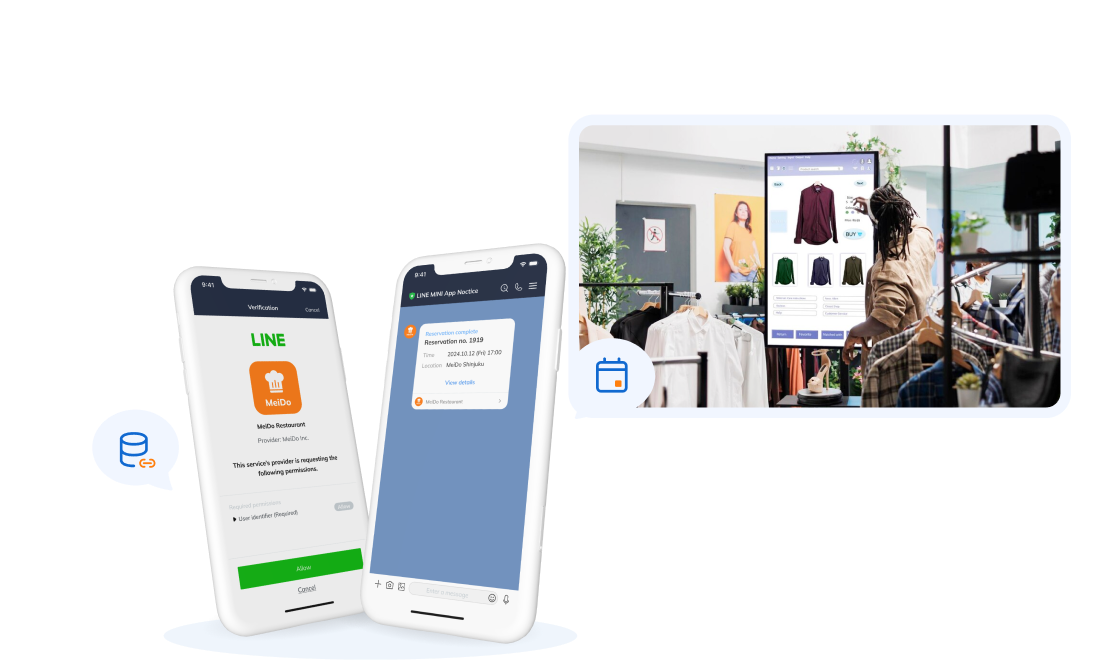
Brand Case Study: SupremeTech helped a global restaurant chain build a loyalty points system connected to mobile apps, POS devices, and point services. The client’s native app served nearly 6 million monthly active users in Japan, and the system had to support real-time point earning, redemption, coupon checks, and POS updates. After release, point-service adoption reached around 15% to 25% in the first six months and later stabilized at 25% to 26%. The system also handled peak concurrent usage of up to 200,000 users every 30 minutes while maintaining stable performance, according to SupremeTech.
This case is relevant to edge computing for retail because it shows the operational cost of delayed transactions. Loyalty points only build trust when the POS, mobile app, and customer record update quickly enough for the customer to believe the system.
In a restaurant environment, the store counter is the performance test. If point redemption slows payment, the experience suffers. If coupon checks fail during peak traffic, staff lose time and customers lose confidence.
Brand Case Study: Target
Brand Case Study: Target changed its inventory operations by using AI-driven inventory management to predict stockouts before they become obvious to store teams. Business Insider reported that Target uses AI-driven inventory management for more than 40% of its product assortment, more than double its coverage from two years earlier. The retailer also makes billions of weekly predictions about how many units each store and online channel will need.
Target’s example shows why store performance depends on faster, more granular operating data. Inventory problems are not only warehouse issues. They become customer experience issues when the item is missing from the shelf, misplaced in the store, or unavailable for pickup.
For retail leaders, the lesson is that inventory intelligence must get closer to store execution. The more localized the signal, the faster teams can prevent availability problems from becoming lost sales.
Brand Case Study: Sam’s Club
Brand Case Study: Sam’s Club used AI-powered exit technology to reduce the friction of receipt checks. Business Insider reported that the technology had been rolled out to more than 120 locations and helped shoppers leave the store 23% faster. The system uses cameras at store exits to compare cart contents against purchases without requiring a traditional manual receipt check.
Sam’s Club is a useful store-performance example because it focuses on one specific bottleneck. The retailer did not begin with a vague goal of “digital transformation.” It targeted an operational pain point customers could feel at the exit.
The result reinforces a practical rule: the best retail infrastructure projects often start with a friction point that is visible, measurable, and repeated many times per day.
In Practice
The SupremeTech case points to transaction reliability, Target points to inventory confidence, and Sam’s Club points to checkout and exit speed. Together, these cases show that edge computing for retail should not be sold as abstract infrastructure. It should be tied to store workflows where speed changes behavior.
What Retail Teams Should Measure After Implementing Edge Computing for Retail
Latency-Sensitive Workflow Performance
The first metric is response time for the workflow that edge infrastructure is meant to improve. Retailers should measure how long it takes for a store event to become an action.
For checkout, that may mean transaction validation time. For inventory, it may mean the time between a shelf gap and an associate task. For pickup, it may mean the time between exception detection and customer communication.
The metric should be measured before and after implementation. Without a baseline, teams cannot prove whether edge architecture created business value.
Inventory and Fulfillment Accuracy
Inventory accuracy should be measured at the level customers experience it. It is not enough for a system to show theoretical availability. The store must be able to find, reserve, pick, and hand over the item.
Retailers should monitor order substitution rates, pickup cancellations, shelf availability, mispick rates, stockroom exceptions, and inventory adjustments after cycle counts.
When these metrics improve, the infrastructure is not merely faster. It is helping the store make better promises.
Associate Productivity and Task Completion
A strong edge strategy should make store work easier to prioritize. If associates receive more alerts but cannot act faster, the design is incomplete.
Teams should measure task completion time, manual search time, number of repeated checks, queue-response time, and exception resolution time.
This is where the store manager’s feedback matters. Dashboards may show faster system response, but store teams can tell whether the new workflow actually reduces friction on the floor.
Customer Experience Signals
Customer metrics should connect to the workflow being improved. For checkout, track queue abandonment, exit time, payment errors, and satisfaction feedback. For inventory, track pickup success, product availability complaints, and purchase conversion.
The Deloitte research is a reminder that customers judge the basics. They care whether inventory is clear, checkout is easy, and updates are reliable.
A store technology project should therefore be measured by practical experience outcomes, not only system uptime.
In Practice
A retailer piloting edge-enabled shelf alerts can create a simple scorecard with four metrics: time to detect the shelf gap, time to assign the task, time to restock, and sales recovery for the affected SKU. That scorecard is easier for store leaders to support than a technical dashboard alone.
How SupremeTech Can Help
The Starting Point Is a Store Workflow Diagnostic
A retailer usually comes to SupremeTech with a practical problem, not an abstract edge strategy. The store team may be struggling with slow POS integrations, inconsistent inventory visibility, delayed loyalty updates, unstable peak-hour performance, or disconnected online and offline customer journeys.
The most useful first step is a diagnostic conversation. Which store event needs a faster response? Which systems are involved? Which delays affect revenue, staff workload, or customer trust? Which workflows must continue if the network is unstable?
This discovery stage often reveals whether the retailer needs edge processing, cloud modernization, application integration, or a hybrid architecture that combines all three.
The Architecture Connects Store, Cloud, and Customer Experience
When the problem sits across store systems and customer channels, SupremeTech’s Omnichannel Retail Solutions can help map the full flow from customer action to store response. This is especially useful for retailers connecting POS, loyalty, order pickup, mobile apps, and customer profiles.
For brands modernizing storefronts, commerce journeys, or store-connected digital services, SupremeTech’s E-commerce Development team can help connect customer-facing experiences with the operational systems behind them.
When store performance depends on scalable infrastructure, monitoring, and deployment reliability, SupremeTech’s Cloud Infrastructure & DevOps practice can design the foundation for traffic spikes, system observability, and controlled rollout across environments.
The Build Should Follow Business Workflows, Not Tool Hype
Retail edge projects become risky when teams start from technology selection instead of operational value. A better path is to define the workflow, identify the timing requirement, design the data movement, and then choose the right infrastructure pattern.
For use cases involving computer vision, prediction, recommendation, or event classification, SupremeTech’s AI-Driven Development team can help translate model outputs into usable store actions. For custom integrations, store-specific applications, or workflow engines, the Custom Software Development team can build around the retailer’s real operating model.
The goal is not to add another system for store teams to manage. The goal is to help the store act faster, recover faster, and serve customers with fewer operational gaps.
If your retail systems are slowing down store execution, start with a diagnostic conversation. SupremeTech can help assess where edge, cloud, AI, and custom software should fit in your store-performance roadmap.
Contact SupremeTech to discuss your next retail infrastructure project.
FAQs Section
Edge computing for retail is an infrastructure approach that processes selected data closer to store systems, devices, and customer interactions. It is useful when a store workflow needs a fast response, such as checkout validation, inventory alerts, queue detection, or loyalty updates. The cloud still matters, but edge handles the decisions that lose value when they arrive late.
The cost of inaction is usually hidden inside operational friction. Customers wait longer, store teams search manually, inventory promises become less reliable, and real-time opportunities are missed. Over time, those issues affect conversion, loyalty, staff productivity, and trust in the brand’s digital channels.
No. Retailers should not adopt edge computing just because it sounds modern. The need depends on whether store workflows require immediate local decisions. A retailer focused on weekly reporting may not need edge, while a retailer running POS-connected loyalty, computer vision, cold-chain monitoring, or high-volume pickup workflows may benefit from a hybrid edge-cloud model.
ROI should be measured by the workflow being improved. For checkout, track transaction time, queue time, exit time, and error rates. For inventory, track pickup cancellations, shelf availability, mispicks, and restock response time. For associates, track manual search time and task completion time before and after implementation.
Scalability risks include inconsistent store networks, device management complexity, data conflicts between local and central systems, unclear ownership of alerts, and security gaps across many locations. A pilot may work in one store but fail across a chain if orchestration and monitoring are not designed early.