








What Is Digital Out of Home? What You Can Learn From the Top DOOH Campaigns in 2026
30/07/2026
272
You’re walking through a city on a hot afternoon when a billboard catches your eye. It’s advertising a frozen drink, and the temperature is printed right on the screen. An hour earlier, on a cooler day, that same billboard was showing something else entirely. Nobody changed the ad by hand, but there is a whole technology story behind it.
That’s digital out of home advertising, or DOOH: ads shown on digital screens in public places like streets, malls, transit stations, and airports, built to update automatically based on data like weather, time of day, or location. Unlike a printed billboard, which shows the same image for weeks, a DOOH screen can change what it shows in real time. That single difference is why DOOH has become one of the fastest-growing parts of advertising, with the global market projected to grow from roughly $22.5 billion in 2026 to more than $56 billion by 2034, according to Fortune Business Insights.
The three examples below show what that looks like when it’s done well. But there’s a bigger story behind all three, one that most articles about DOOH skip entirely: The secret that makes a DOOH worth your business investment.
What Is Digital Out of Home (DOOH) Advertising?
Out of home advertising isn’t new. Roadside billboards and posters have been around for over a century, offering brands a simple way to reach a lot of people in one place. The catch was always flexibility. Once a poster went up, it stayed the same until someone physically replaced it.
Digital out of home combines digital screens with data-driven marketing, letting brands update creatively based on things like audience, location, or time. A billboard doesn’t need a maintenance crew to change anymore. It just needs a connection and the right data feeding into it.
This matters more than it sounds like it should, because it turns a billboard from a static object into something closer to a website: something that can be tested, updated, and measured. That shift is the whole reason DOOH keeps growing while printed billboards stay roughly flat.
How DOOH Actually Works Behind the Screen
Most DOOH screens today aren’t booked the old-fashioned way, with a phone call and a four-week contract. A growing share is bought programmatically, through automated auctions similar to how online display ads are sold, which makes it faster and easier for brands to get their creative in front of the right screens at the right time.
Once a campaign is live, dynamic creative takes over. A screen can be set to show one message when it’s raining and another when it’s sunny, one version during the morning commute and a different one at lunch. The Out of Home Advertising Association of America has found that DOOH delivers meaningfully higher reach and cost efficiency compared to traditional formats like TV, which is part of why bigger brands keep shifting budget into it.
None of this works without one thing: data. A screen that reacts to weather needs a live weather feed. A campaign that claims to reach a certain audience needs a way to actually measure who saw it. That measurement layer is the least glamorous part of DOOH, and also the part that decides whether a campaign is remembered as a success or just written off as an experiment.
3 Most Inspiring Examples of DOOH Advertising in 2026
McDonald’s UK: Ads That Change With the Weather
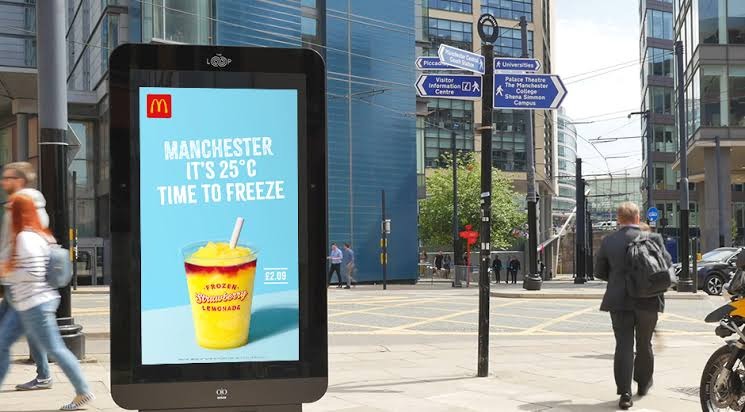
McDonald’s ran a DOOH campaign in the UK promoting two frozen drinks, a strawberry lemonade and a frappe. The screens were connected to live temperature data. Once it hit 22 degrees Celsius, the frozen drink ad appeared. Past 25 degrees, the screen added the city name and the exact temperature, making the ad feel like it was speaking directly to whoever was standing underneath it.
What makes this example worth studying isn’t the drinks. It’s the timing. A static poster would have run for weeks regardless of the weather, wasting impressions on cold, rainy days when nobody wants a frozen drink. The weather trigger meant the ad only worked as hard as it needed to, exactly when it was most likely to convert.
Netflix’s 3D Billboards That Step Into the Street
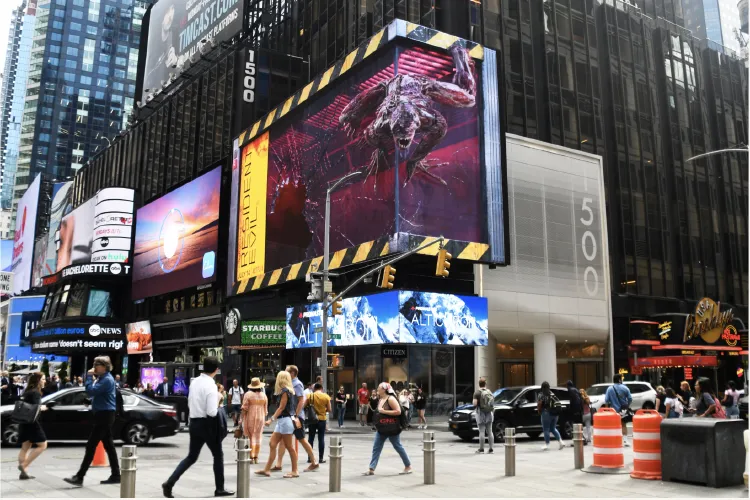
Netflix has leaned into 3D anamorphic billboards, the kind where characters appear to physically step out of the screen and into the street. These installations use large-format LED displays and forced perspective to create an illusion that only works from certain angles, turning a normal city intersection into something people stop to film and share.
Interestingly, this exact technology is already a signature part of Tokyo’s advertising scene. Districts like Shinjuku and Omotesando are known globally for their 3D anamorphic LED screens, and Tokyo’s overall DOOH market has grown large enough that digital screens now account for more than 60 percent of total out of home ad spend in the city, according to AdQuick’s 2026 market analysis. Campaigns like Netflix’s aren’t just creative stunts. They’re built on display technology that cities like Tokyo have already scaled into everyday advertising infrastructure.
Spotify Wrapped: Turning Listener Data Into Outdoor Ads
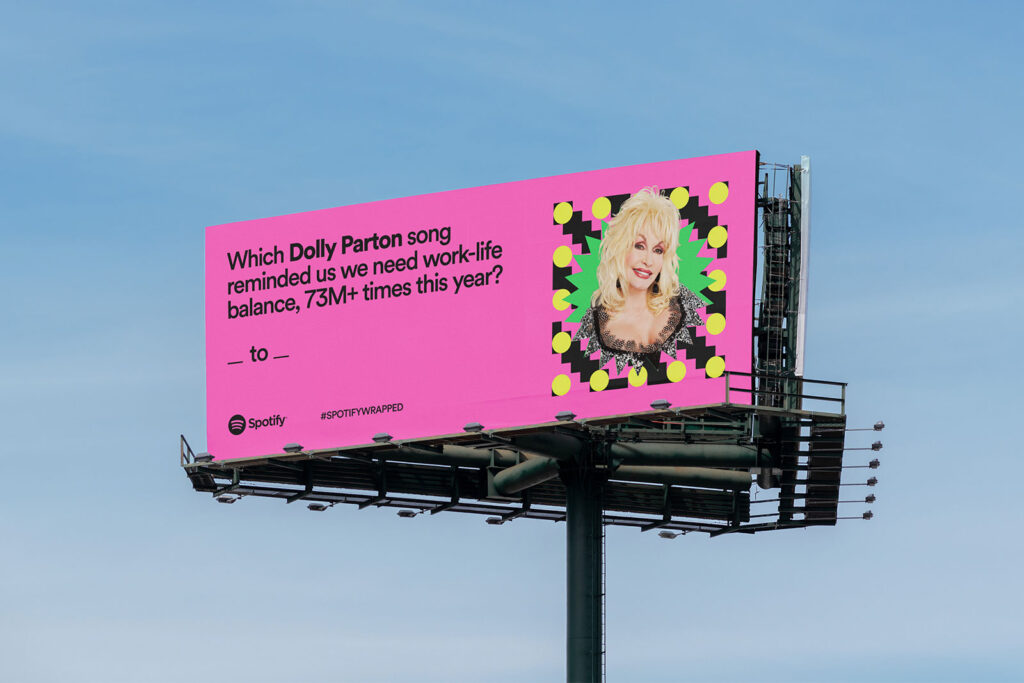
Spotify’s Wrapped campaign, which started as an in-app feature showing users their year in music, has become one of the most recognizable examples of DOOH done well. Spotify takes anonymized, aggregated listening data and turns it into bold, playful outdoor ads, like a billboard joking about how many hours someone spent listening to a specific artist.
The reason this campaign keeps working year after year is that it isn’t really about music. It’s about personalization at scale. The billboard doesn’t feel like generic advertising because it’s built directly from real user data, and that small shift, from a generic message to one that reflects something specific and real, is a large part of why the campaign gets shared organically every single year.
What These Campaigns Actually Have in Common
McDonald’s, Netflix, and Spotify look like three completely different campaigns: A weather trigger, a 3D projection, a data-personalized joke. But all three depend on the same invisible layer underneath: a live feed of data reaching the screen, and a way to measure what happened afterward.
Measurement is where most companies entering DOOH get stuck. It’s one thing to buy screen space. It’s another to prove which screens actually drove results, especially when a campaign runs across dozens or hundreds of digital billboards from different vendors.
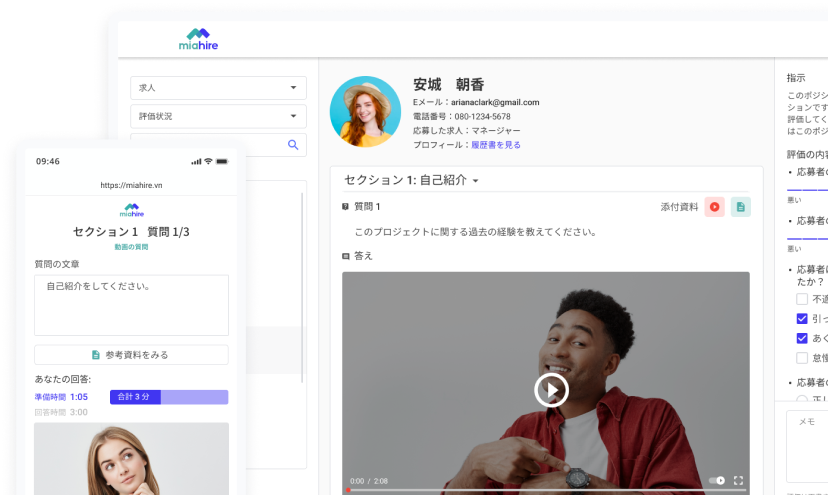
SupremeTech ran into exactly this problem while working with Search Inc., a company in Tokyo’s growing digital OOH analytics space. Search collects audience and impression data from digital billboards across the city and needed a way to actually show that data to advertisers and billboard owners, rather than leaving it buried in raw exports nobody could act on. SupremeTech built the web application and dashboard to do it: a React front end running on AWS, pulling in impression data in real time and presenting it in a format non-technical users could actually read.
The hardest part of the project wasn’t the interface. It was earlier than that. The team first had to pin down exactly what each data point meant and how it was calculated, since a number like “impressions” can be defined differently depending on the sensor or vendor behind it. Only after that was settled could the dashboard be built to sync correctly with digital billboards scattered across Tokyo, including data coming from a separate third-party vendor that had to be reconciled with Search’s own numbers. Three months later, billboard owners and advertisers had a single dashboard showing real-time impressions and reach, something they could actually use to price inventory and prove campaign value.
This is the part of DOOH that never makes it into a “best campaigns” list, but it’s the part that decides whether a brand can confidently say a campaign worked, or is just guessing.
The Technical Work Behind Every Data-Driven OOH Campaign
The Search Inc. project is one example, but the underlying problem shows up anywhere a business is trying to turn raw ad or sensor data into something people can actually use to make decisions. A few pieces tend to come up again and again in this kind of work:
Getting the data pipeline right usually matters more than the dashboard itself. Impression counts, audience estimates, and sensor readings often arrive from multiple vendors, in different formats, on different schedules. Before anything gets visualized, it has to be normalized into one consistent definition, or a dashboard just shows confident-looking numbers that don’t actually agree with each other.
Cloud infrastructure has to handle bursts, not just steady traffic. A billboard network doesn’t send data at a smooth, predictable rate. Impressions spike during rush hour, events, or weather triggers, and a system built on plain averages tends to fall behind exactly when the data matters most. This is the kind of problem SupremeTech’s cloud infrastructure and DevOps work is built around: architecture that scales up automatically when real-world activity spikes, rather than being sized for an average day.
There’s also room for AI here, beyond just visualizing what already happened. Predicting which locations or time windows will perform best, or automatically flagging when a sensor’s numbers look inconsistent with the rest of the network, are natural next steps once the underlying data pipeline is solid. SupremeTech’s AI-driven development approach is built for exactly this kind of layer: adding intelligence on top of a system, rather than trying to bolt AI onto data that isn’t clean enough to support it yet.
None of this is unique to OOH. The same pattern shows up in retail, e-commerce, and loyalty systems, anywhere a business is sitting on data from multiple sources and needs one reliable place to see what it means. If your team is dealing with a similar problem, whether it’s ad-tech, retail data, or another connected system, it’s worth exploring SupremeTech’s custom software development work or browsing more case studies to see how these projects tend to unfold in practice.
How to Know If DOOH Is Right for Your Brand
Before booking screen space, it’s worth checking a few things first:
Does your audience actually pass through the locations you’re considering? DOOH works best where there’s real foot or vehicle traffic that matches your target audience, not just wherever inventory happens to be cheap.
Do you have a real reason to use dynamic creative, or would a static image do the same job? Weather, time, and location triggers only add value if they change the message in a way that matters.
Can you measure the campaign after it runs? Ask any vendor exactly how impressions and reach are calculated before you buy, not after the campaign ends.
Does your budget support programmatic buying, or are you better off with a direct booking? Programmatic gives more control and flexibility but usually needs a bigger, more active budget to make sense.
Who owns the data and the dashboard once the campaign is live? If the answer is “the vendor,” you may end up with results you can’t independently verify.
None of these questions require a huge budget to answer. They just require asking them before signing a contract, not after.
The Real Race in DOOH Isn’t the Screen Size
The creative side of DOOH will keep getting more impressive: bigger screens, sharper 3D effects, faster real-time triggers. That part is easy to get excited about, and it should be.
But the more important shift is happening underneath the screen, in the data pipelines and dashboards that turn a flashy campaign into something a brand can actually measure and repeat. Asia Pacific is leading a lot of this growth, with markets like Japan investing heavily in both screen infrastructure and the analytics behind it.
If there’s one thing worth remembering from all three examples above, it’s this: the campaigns that get remembered aren’t just the ones with the best idea. They’re the ones where someone made sure the data behind the screen actually worked.
If your team is building something in this space, whether it’s an OOH dashboard or another data-heavy project, SupremeTech is happy to talk through what that would actually take.
FAQs Section
DOOH is advertising shown on digital screens in public spaces like streets, malls, and transit stations. Unlike a printed billboard, it can update automatically based on data such as weather, time, or location.
Traditional OOH uses printed, static creative that stays the same until it’s physically replaced. DOOH uses digital screens that can change content in real time and be measured more precisely.
Beyond a strong creative idea, successful DOOH campaigns depend on reliable data feeding the screens and a way to measure impressions and reach afterward, so results can actually be verified.
It depends on the buying method. Programmatic DOOH offers more flexibility and control but generally needs a more active budget than a single static billboard booking.
Performance is typically measured through impression and reach data collected from sensors or vendors tied to each screen, often visualized in a dashboard so advertisers and billboard owners can evaluate campaign value.