









Best Practices for Retail Customer Data Platform Success in Modernizing Omnichannel Systems
05/05/2026
530
Introduction
Best practices for retail customer data platform projects usually have less to do with the platform itself than many teams expect. The real challenge is rarely just choosing a CDP or connecting a few channels. It is building a data foundation that can unify customer information across ecommerce, POS, CRM, loyalty, customer service, and marketing systems without creating more fragmentation as the business grows.
This is why many retail CDP initiatives become more complex after the first implementation phase. On paper, the goal sounds straightforward: create a single customer view and use it to improve personalization, reporting, and customer engagement. In reality, retail environments often involve legacy systems, channel-specific tools, inconsistent customer identifiers, and data flows that were never designed to work together. As a result, the success of a retail customer data platform depends not only on software selection, but also on integration quality, modernization planning, and long-term operational discipline.
For decision-makers, this changes the conversation. A retail CDP should not be treated as a standalone marketing tool. It should be evaluated as part of a broader retail platform architecture. The businesses that get stronger results are usually the ones that approach the CDP as an integration and modernization initiative, not just a data aggregation project. That is where best practices start to matter, because they help ensure the platform remains usable, scalable, and valuable across channels over time.
Why Retail Customer Data Platforms Often Fall Short
Retail customer data platforms often underperform not because the business lacks customer data, but because the surrounding systems were never designed to create one consistent customer view. Retailers usually operate across physical stores, ecommerce sites, mobile apps, loyalty platforms, CRM tools, customer support channels, and marketing automation systems. Each of these can hold useful information, but they often use different formats, different update cycles, and different ways of identifying the same customer.
That creates a common problem. The CDP receives data from many places, but the data arriving inside it is not always aligned enough to support confident action. Profiles may be duplicated, purchase histories may be incomplete, in-store and online behavior may not connect properly, and reporting may still vary across departments. In that situation, the business technically has a customer data platform, but it does not yet have a reliable customer data foundation.
Another reason retail CDPs fall short is that implementation often moves faster than modernization. Teams focus on getting data into the platform, but not enough on whether the systems feeding it are stable, clean, and maintainable. Legacy POS environments, older ERP connections, disconnected loyalty systems, and custom integrations built over time can all limit the usefulness of the CDP. Instead of simplifying the data landscape, the platform can end up sitting on top of the same underlying complexity.
This is why retail CDP success depends on more than feature availability. It depends on whether the integration model, data structure, and modernization priorities are strong enough to support real business use. For retailers operating across multiple channels, the CDP is only as effective as the environment around it.
Best Practices for Retail Customer Data Platform Success
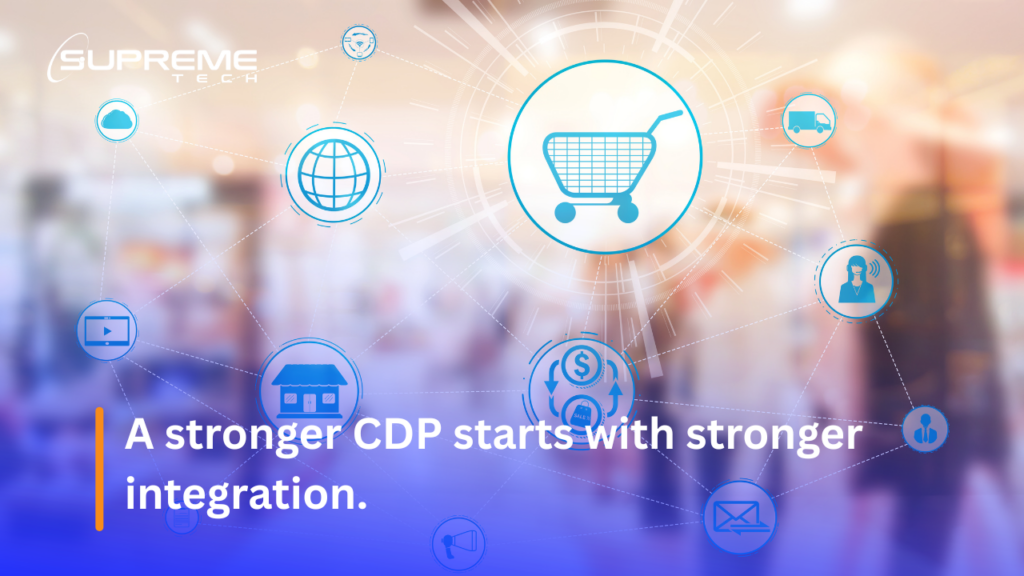
1. Start with a Unified Customer View, Not Just Data Collection
At the core of every effective CDP is the ability to create a single, persistent customer profile by integrating data from multiple sources such as POS systems, eCommerce platforms, mobile apps, and CRM tools.
This unified view is essential in omnichannel retail, where customers expect seamless interactions across online and offline channels. Without it, businesses risk fragmented experiences, inconsistent messaging, and missed opportunities to personalize engagement.
Best practice:
- Prioritize identity resolution and data unification early
- Focus on stitching customer journeys across channels, not just aggregating raw data
2. Design for True Omnichannel Integration
Omnichannel success is not about having multiple channels. It is about making them work together as one system. Customers increasingly expect to start their journey in one channel and complete it in another without friction.
A retail CDP should act as the central layer that synchronizes data in real time across marketing, sales, and customer service systems.
Best practice:
- Enable real-time data synchronization across channels
- Ensure all systems (marketing automation, POS, loyalty, support) consume the same customer data
- Map end-to-end customer journeys, not isolated touchpoints
3. Focus on Data Quality and Governance from Day One
A CDP is only as valuable as the quality of the data it processes. Poor data quality leads to inaccurate segmentation, irrelevant campaigns, and loss of customer trust.
Research shows that effective omnichannel strategies rely heavily on clean, actionable, and well-managed data to drive personalization and engagement.
Best practice:
- Implement data cleansing, deduplication, and validation pipelines
- Establish clear data ownership and governance policies
- Regularly audit data sources and flows
4. Enable Real-Time Personalization at Scale
Modern retail is driven by personalization. Customers expect relevant offers, recommendations, and interactions based on their behavior and preferences.
A CDP enables this by making unified customer data available for activation across channels, supporting tailored experiences in real time.
Best practice:
- Use behavioral and transactional data to trigger real-time actions
- Move beyond batch campaigns to event-driven engagement
- Align personalization strategies across marketing, sales, and in-store experiences
A strong real-world example is Sephora, which integrates customer data across digital and physical channels to empower store associates with personalized insights, improving both engagement and conversion.
5. Build a Flexible, Scalable Data Architecture
Retail environments evolve quickly, and your CDP architecture must be able to adapt. Gartner highlights that successful digital transformation in retail depends on flexible technology foundations aligned with business goals.
This means avoiding rigid, siloed systems and instead adopting modular or composable architectures that can scale with new channels, data sources, and use cases.
Best practice:
- Choose scalable infrastructure (cloud-native or warehouse-based CDP models)
- Design for extensibility with APIs and modular components
- Avoid vendor lock-in where possible
6. Align CDP Strategy with Business Outcomes
One common mistake is treating CDP implementation as an IT project rather than a business initiative. Leading retailers connect their CDP strategy directly to measurable outcomes such as revenue growth, customer retention, and campaign efficiency.
McKinsey emphasizes that omnichannel success requires coordination across operations, analytics, and customer strategy, not just technology deployment.
Best practice:
- Define clear KPIs (e.g., customer lifetime value, conversion rate, retention)
- Align CDP use cases with marketing and operational priorities
- Continuously measure and optimize performance
7. Break Down Organizational Silos
Technology alone cannot fix disconnected customer experiences. Many retail challenges come from internal silos between teams such as marketing, eCommerce, store operations, and customer service.
A CDP should serve as a shared data foundation that enables cross-functional collaboration.
Best practice:
- Create shared data access across teams
- Standardize metrics and reporting across departments
- Encourage collaboration between business and technical teams
Read related blogs about Customer Data Platform:
- What is the Customer Data Pipeline? Best Practices for Non-Tech Marketers
- How to Build a Cloud-Based Customer Data Pipeline for Omnichannel Retail
Why the Right Technology Partner Matters
A retail customer data platform does not succeed on platform capability alone. The real challenge usually sits in the surrounding environment: fragmented customer data, legacy retail systems, inconsistent identifiers, and channel-specific tools that were never designed to work together. That is why CDP success often depends as much on integration and modernization quality as on the platform itself.
For decision-makers, this is an important point. A partner should not only be able to connect systems technically. They should also be able to help the business decide what to integrate first, where legacy constraints need modernization, and how to build a data foundation that remains stable as channels and customer expectations continue to evolve. Without that broader view, even a strong CDP can become difficult to trust or scale.
This is where SupremeTech can support retail businesses more effectively. SupremeTech’s capabilities are not limited to implementation alone. They also include retail platform integration, system modernization, custom digital product development, and offshore development support for businesses that need a practical and scalable delivery model. For companies evaluating how to connect customer data across ecommerce, POS, CRM, loyalty, and internal systems, those capabilities matter because the CDP is only one part of the solution.
If your challenge is broader than platform setup, it may be useful to explore SupremeTech’s service pages in Retail Platform Integration, System Modernization, and Digital Product Development.
Conclusion
Best practices for retail customer data platform projects are not just about choosing the right platform or connecting more systems. They are about building a customer data foundation that can support real retail operations across ecommerce, stores, CRM, loyalty, service, and future digital channels.
That is why retail CDP success depends on more than software features. It depends on how well the business handles integration priorities, identity resolution, legacy system constraints, governance, and long-term scalability. For decision-makers, this means the real value of a CDP comes from how well it fits into a broader modernization strategy, not how quickly it can be deployed in isolation.
For companies evaluating this journey, the key question is not only how to launch a retail CDP, but how to make it work sustainably within a complex retail environment. Contact SupremeTech to know where best practices matter, and where the right integration and modernization approach can make the platform far more valuable over time.
FAQs Section
The best practices for retail customer data platform implementation include prioritizing the right systems first, resolving customer identity early, designing for future scale, modernizing legacy dependencies, balancing real-time and batch integration, and building governance into the implementation from the start.
Retail customer data platforms often fall short because the surrounding systems are fragmented. Ecommerce, POS, CRM, loyalty, and service platforms may all hold useful customer data, but without strong integration and modernization, the CDP cannot create a reliable customer view.
Integration is important because a retail CDP depends on connected data from multiple channels. Without strong integration, the platform may collect data but still struggle with duplicate profiles, incomplete histories, and inconsistent reporting across teams.
Legacy systems can limit retail customer data platform success when they are difficult to connect, unstable, or based on outdated data structures. In many retail environments, modernization is necessary to make the CDP reliable and scalable.
Decision-makers should evaluate core data sources, integration complexity, identity resolution needs, governance readiness, legacy system constraints, and whether the delivery partner can support both implementation and long-term modernization.
SupremeTech supports retail customer data platform projects through retail platform integration, system modernization, custom digital product development, and offshore development support that helps businesses build a more scalable and maintainable retail technology foundation.