







POS System With Loyalty Program: A Japan Integration Checklist for Retail and F&B
21/10/2026
13
A POS system with loyalty program support works in Japan only when two jobs stay separate. The POS owns the transaction, the receipt and the tax. The loyalty engine owns the member, the balance and the rules. Integration is the agreement between them on five flows: identify, earn, redeem, reverse and reconcile.
Most guides stop at “pick a POS that has loyalty built in.” That advice breaks down quickly in Japanese stores. Cashless payment reached 58.0% of consumer spending in 2025, according to METI’s latest cashless payment ratio, so most checkouts already involve a card, a QR code or a point network. Add two consumption tax rates and the eat-in or take-out question, and a loyalty redemption is no longer a simple discount line.
This guide helps operations, IT and CRM leads choose an integration model and then work through a seven-step checklist they can share with their POS vendor or development partner.
Built-in, connected or custom: which POS loyalty model fits?
The right model depends on how many channels and point programs must share one balance. Built-in loyalty is fastest; custom loyalty gives the most control but takes the most work.
| Criteria | Built-in POS loyalty | Connected loyalty platform | Custom points engine |
| Best fit | Single brand, stores only | Stores plus e-commerce or app | Several brands, channels or countries |
| Tax-rate handling on redemption | Depends on the POS vendor’s Japan version | Must be agreed between two vendors | Designed to your receipt rules |
| National point networks at the same till | Limited to what the POS supports | Possible, but sequencing must be specified | Fully configurable |
| Peak-hour load | Shared with the POS | Extra API call per transaction | Sized for your own peaks |
| Main risk | Outgrowing the module | Two vendors blaming each other | Build and maintenance cost |
A practical rule: if your balance must appear in more than one channel, or you run your own points next to a national network, plan for a connected or custom model from the start.
Step 1: Decide which system owns what
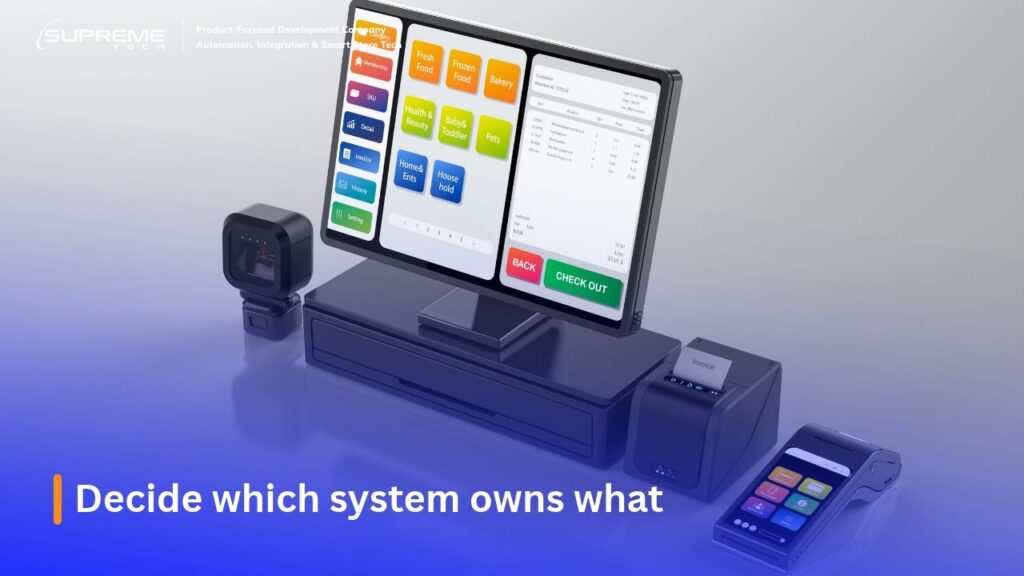
Write down one owner for every piece of data before any API is designed. The POS should own items, prices, tax rates, tenders and the receipt. The loyalty engine should own member status, point balance, expiry and campaign rules. When both systems store a balance, they will eventually disagree, and the customer will notice first.
Read more:
Step 2: Agree how the customer is identified at the till
The POS needs one fast way to find the member, usually an app barcode, a card number or a phone number. Agree the lookup order, what happens when no match is found, and whether staff can attach a member after payment. Keep matching rules in your customer data layer, not in the POS.
Read more:
Step 3: Map earn and redeem to Japan’s two tax rates

This is the step most overseas guides miss. Japan taxes take-out food at the reduced 8% rate, while eating in, alcohol and most non-food items are taxed at 10%, as shown in the Ministry of Finance’s reduced tax rate summary. When one discount covers items at both rates, the National Tax Agency’s invoice system Q&A (Question 69) says tax applies to the discounted amounts for each rate, and the receipt must make those amounts clear.
Here is an illustrative example. A customer buys a take-out bento for ¥756 (8%) and a ¥2,200 household item (10%), then redeems 300 points worth ¥300 as a discount. Splitting the discount by price ratio, as the NTA example does, gives the following receipt values. The figures assume tax-inclusive prices and rounding down once per rate.
| Line | 10% items | 8% items | Total |
| Before redemption | ¥2,200 | ¥756 | ¥2,956 |
| Points allocated | ¥223 | ¥77 | ¥300 |
| After redemption | ¥1,977 | ¥679 | ¥2,656 |
| Consumption tax shown | ¥179 | ¥50 | ¥229 |
If the POS treats the same points as a payment method instead, the receipt shows ¥256 of tax on the full ¥2,956. The NTA’s guidance on point use at purchase confirms that the two treatments produce different taxable amounts, and that business customers read the treatment from the receipt. Which treatment applies to your program is a decision for your tax adviser. The integration must then follow it consistently.
Two more rules belong in the specification:
- Earn base. Earning 1 point per ¥100 on the paid amount gives 26 points in this example. Earning on the pre-redemption amount gives 29. Either can work, but every channel must use the same rule.
- Eat-in changes. In F&B, the same menu item moves between 8% and 10% depending on where it is eaten. If an order switches after the member is identified, the POS must recalculate the split before sending the redemption.
Step 4: Plan for national point networks at the same counter
Many Japanese customers expect to use a network point card, such as Rakuten Points, d POINT, V Point or Ponta, alongside your own program. Specify the order in which programs are applied, which one is a discount and which is a payment, and how both appear on one receipt. Test this with your network provider’s certified flow before launch.
Read more:
Step 5: Design refunds, voids and offline mode
Every action that reverses a sale must also reverse its points. Write these rules down, because a POS vendor and a loyalty vendor will each assume the other handles them.
| Event at the POS | What the loyalty engine should do |
| Full refund | Remove earned points and return redeemed points |
| Partial refund | Recalculate both, using the original tax split |
| Same-day void | Cancel the whole loyalty transaction with the sale ID |
| Points expired before refund | Follow a written policy, decided in advance |
| Network outage | Queue earns locally; block redemptions or allow a capped amount |
Offline mode matters most at lunch peaks. Earning can safely wait and sync later. Redemption cannot, because an unchecked balance can be spent twice.
Step 6: Handle member data within APPI
A connected or custom model usually sends member data from the POS to another service. Under Japan’s Act on the Protection of Personal Information, a business must specify the purpose of use and generally needs prior consent before providing personal data to a third party, with separate rules when processing is entrusted to a contractor. Check your privacy notice, your vendor contract and any overseas data storage with legal counsel before go-live.
Step 7: Test with real receipts before rollout
Build test cases from real baskets, not from the vendor’s demo. At minimum, test mixed 8% and 10% baskets, eat-in switches, partial refunds, redemptions larger than the basket, two point programs in one sale, and an outage in the middle of a lunch rush. Pilot in a few stores and compare loyalty balances against POS sales every day.
Read more:
What this looks like in a real project
A real SupremeTech project shows why ownership and reconciliation come first. A Japanese luxury jewelry retailer ran two sales channels with different point structures, tiers and redemption logic, and Shopify offered no native way to import, map or reconcile points between them. SupremeTech mapped the tier, expiry and redemption rules from both channels, built a custom Shopify app with one rules-based point system, and added a batch sync so the online store and in-store POS showed the same points. According to the case study, customer complaints about missing or delayed points fell, and the marketing team could run campaigns without manual reconciliation.
How SupremeTech can help

SupremeTech usually starts with a short diagnostic: who owns which data today, how receipts handle redemptions, and where balances drift between channels. From there, our omnichannel retail solutions team connects POS, e-commerce and app loyalty, and our custom software development team builds points engines and integrations when a built-in module is not enough.
Conclusion
A POS system with loyalty program features is easy to buy and hard to run well in Japan. The integration succeeds when the POS and the loyalty engine agree on ownership, tax-rate splits, reversals and point networks before the first customer scans a barcode. Use the seven steps above as your requirements checklist, and test them with real receipts.
Planning a loyalty integration for stores in Japan? Talk to SupremeTech about your current POS setup and we will help you map the right model.
Frequently Asked Questions
It is a point-of-sale setup that identifies members at checkout and earns or redeems rewards within the same transaction. The loyalty logic can be built into the POS, provided by a connected loyalty platform, or run by a custom points engine.
Not usually. Most retailers connect a loyalty platform or custom points engine to their existing POS through an API. Replacement makes sense only when the current POS cannot pass item-level data, tax rates or member IDs in real time.
When points are treated as a discount across items taxed at 8% and 10%, the receipt should show the discounted amount for each tax rate. Confirm with a tax adviser whether your program’s points are a discount or a payment method.
Yes. Specify the order in which programs apply, which one acts as a discount and which as a payment, and test the combined receipt with the network provider before launch.
A common design queues point earning locally and syncs it later. Redemptions are blocked or capped during an outage, because an unverified balance could be spent twice.
It depends on the model. Built-in loyalty can be configured quickly, while connected or custom integrations need time for data-flow design, tax and refund rules, and in-store testing. Ask vendors for a phased plan with a pilot.