









Software Product Modernization for Omnichannel Retail: Where to Start and What to Prioritize
07/05/2026
453
Software product modernization becomes urgent in omnichannel retail when the business starts expecting more from systems that were never designed to work together. A retailer may already have ecommerce, store systems, inventory tools, customer data platforms, order management flows, and internal reporting in place. The problem is that these systems often grew at different times, for different needs, and with limited integration between them. As omnichannel expectations rise, that fragmented setup becomes harder to manage and harder to scale.
That is why software product modernization in retail should not be treated as a simple technology refresh. The real question is not whether the business should modernize, but where to start and what to prioritize first. In most retail environments, trying to modernize everything at once creates more risk than value. A stronger approach is to identify which systems create the biggest friction for omnichannel operations, customer experience, and future delivery speed, then modernize in a way that reduces fragmentation instead of adding another layer on top of it.
This article focuses on that practical question. It explains where software product modernization should begin in omnichannel retail, what leaders should prioritize first, and how to approach modernization in a way that supports integration, scalability, and long-term business value.
Why Software Product Modernization Matters More in Omnichannel Retail
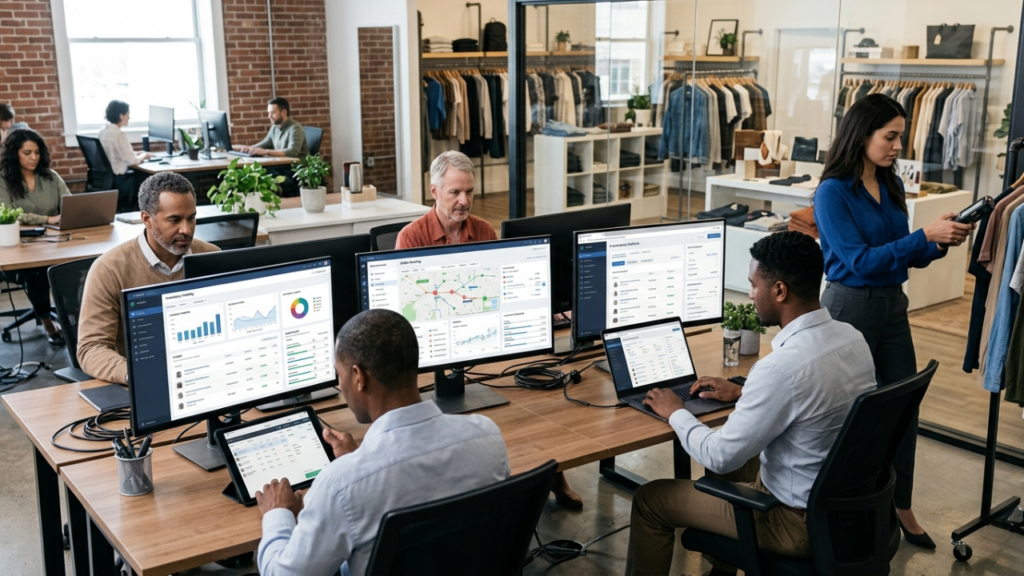
Software product modernization matters more in omnichannel retail because customer experience now depends on how well digital and physical retail systems work together. Customers expect inventory visibility across channels, smoother fulfillment options, consistent pricing and promotions, and fewer gaps between browsing, buying, pickup, returns, and service. When the underlying systems are fragmented, those experiences become harder to deliver.
This is where many retailers feel the pressure. Older store systems, separate ecommerce layers, limited integration, and duplicated data flows may still support day-to-day operations, but they often slow down change and create friction across channels. McKinsey highlights that limited integration between newer ecommerce capabilities and legacy systems has made it harder for retailers to implement true omnichannel journeys, while Deloitte’s retail modernization guidance says legacy complexity can hold back innovation, agility, and growth.
What Software Product Modernization Actually Means in a Retail Context
In omnichannel retail, software product modernization does not mean rewriting everything or moving every system to a newer stack. In practice, it means improving the parts of the retail platform that are creating the most friction for customer experience, operations, and future delivery.
A practical way to think about modernization is to focus on four questions:
| Question | What it means in real retail work | Why it matters |
| Which systems create the biggest omnichannel friction? | Inventory, order management, pricing, promotions, customer data, POS, returns, fulfillment | These are usually the areas where disconnected systems hurt both customer experience and operations |
| Which systems are hardest to change today? | Legacy store systems, tightly coupled back ends, batch-based integrations, brittle internal tools | These often slow feature rollout and force teams into manual workarounds |
| Which capabilities does the business need next? | Real-time stock visibility, click-and-collect, cross-channel returns, store fulfillment, better personalization | Modernization should support the next stage of retail growth, not just clean up technical debt |
| Which improvements reduce complexity instead of adding to it? | Better APIs, modular services, cleaner data flows, retirement of duplicate tools | This helps the business modernize without layering more fragmentation on top |
In real projects, modernization usually starts with capability gaps, not with a platform replacement decision. For example, a retailer may discover that:
- store and ecommerce inventory are not aligned well enough to support real-time availability
- order and return flows break when customers move between channels
- pricing or promotions behave differently across systems
- each new omnichannel feature takes too long because too many systems need custom changes
That is a stronger starting point than saying “we need to modernize the whole platform.”
What modernization usually includes in practice
In retail, software product modernization often involves a mix of these actions:
| Modernization move | What it looks like | Typical retail value |
| Replace or refactor brittle core workflows | Rework order flows, inventory sync, returns logic, customer identity handling | Reduces friction in high-impact omnichannel journeys |
| Improve integration between old and new systems | Add more stable APIs, event flows, middleware, or data synchronization layers | Makes it easier for ecommerce, store systems, and operations to work together |
| Break large systems into more manageable components | Modularize services around pricing, catalog, promotions, loyalty, or fulfillment | Improves release speed and reduces dependency bottlenecks |
| Retire duplicate or low-value tools | Remove overlapping internal tools or one-off fixes that teams rely on | Lowers operational complexity and maintenance cost |
| Improve data consistency across channels | Align product, customer, order, and inventory data models | Supports more reliable omnichannel execution |
This matters because omnichannel retail is rarely blocked by one single system. It is usually blocked by a combination of legacy logic, fragmented data, and slow cross-system change. Bain describes retail technology modernization as difficult partly because legacy systems are complex, costly to maintain, and fragmented across layers of the stack, making coordinated change harder.
A practical rule for where to start
If a retailer wants to know where modernization should begin, a useful rule is: Start where system fragmentation is already hurting revenue, operations, or customer trust.
In real omnichannel retail, that often means starting with one of these:
- inventory visibility
- order and fulfillment orchestration
- POS and ecommerce integration
- promotions and pricing consistency
- returns and exchange workflows
- customer data consistency across channels
That is usually much more effective than starting with a broad platform rebuild.
Where to Start First in Software Product Modernization for Omnichannel Retail

The best place to start is usually not with the oldest system. It is with the point where legacy complexity is already hurting omnichannel retail the most. In real retail environments, that often means the systems and workflows behind inventory visibility, order orchestration, pricing consistency, returns, or store and ecommerce coordination. In practice, most retailers do better when they prioritize one or two high-friction capabilities instead of trying to modernize the whole platform at once.
A practical starting point is to assess modernization through business friction first.
| Start here if the business feels this pain | What to modernize first | Why this is usually a strong starting point |
| Stock visibility is unreliable across channels | Inventory data flows, product master data, store and ecommerce synchronization | Inventory is one of the clearest omnichannel failure points and affects both customer experience and operations |
| Cross-channel fulfillment is slow or inconsistent | Order management, fulfillment logic, store fulfillment workflows, returns orchestration | Omnichannel convenience depends heavily on how orders move across systems and locations |
| Promotions and pricing behave differently by channel | Shared pricing engines, promotion logic, API integration between commerce and store systems | Inconsistent offers damage trust and create operational friction fast |
| New digital features take too long to launch | Core integration layer, brittle back-end workflows, tightly coupled services | Slow delivery is often a sign that the platform is too rigid, not just understaffed |
| Teams rely on manual workarounds to keep channels aligned | Internal tools, duplicate systems, batch sync jobs, one-off integrations | Manual patches usually signal where modernization will create the most immediate operational value |
A practical sequence retailers can follow
A simple and realistic modernization sequence often looks like this:
- Map the customer-facing friction to the systems behind it
Start with the business problem customers or store teams already feel. That could be inaccurate store availability, poor click-and-collect execution, weak returns handling, or pricing mismatches. Then identify which systems create that friction. - Separate integration problems from core-system problems
Some issues come from poor integration between systems. Others come from the system itself being too rigid, too old, or too manual. This distinction matters because not every pain point requires replacing a core platform. - Prioritize the capabilities that unblock omnichannel growth
In many retailers, that means inventory visibility, order orchestration, or shared customer and transaction data before more advanced experience layers. - Reduce complexity while modernizing
If modernization only adds new layers, APIs, or tools without retiring old dependencies, the architecture may look newer but become harder to maintain. - Modernize in phases with clear business value
A phased approach is often more realistic in retail because stores, operations, and customer journeys cannot absorb unlimited change at once. Deloitte’s retail modernization guidance also supports modernization strategies aligned to business priorities and risk tolerance rather than open-ended transformation.
What this often looks like in real omnichannel retail
In many omnichannel retail environments, the first modernization wave is not glamorous. It may involve:
- replacing brittle data sync jobs between store and ecommerce systems
- cleaning up inventory and product data flows
- improving order-routing logic
- reducing duplicate internal tools
- adding more reliable APIs between old and new platforms
- replacing brittle data sync jobs between store and ecommerce systems
- cleaning up inventory and product data flows
- improving order-routing logic
- reducing duplicate internal tools
- adding more reliable APIs between old and new platforms
Read related articles about Retail:
- How Customer Data Turns into Personalized Retail Experiences
- How can Fashion Retailers Connect Online and In-Store Experiences for Omnichannel Growth?
- How to Build a Cloud-Based Customer Data Pipeline for Omnichannel Retail
What Retail Leaders Should Prioritize First
In omnichannel retail, the strongest priorities are often the ones that sit closest to customer friction and operational breakdown. Research on omnichannel retail consistently shows that connected inventory, fulfillment, store coordination, and integrated customer experience are where traditional retailers either win or struggle. HBR has emphasized that omnichannel success depends on turning stores into an asset rather than running digital and physical channels as separate worlds.
A practical way to prioritize is to focus on the few areas where modernization creates both customer-facing and operational value.
| Priority area | What leaders should look for | Why it usually comes first |
| Inventory and order visibility | Stock accuracy across channels, delayed order routing, weak pickup or ship-from-store execution | These problems affect conversion, service reliability, and store efficiency at the same time |
| Cross-channel consistency | Promotions, pricing, returns, and loyalty behaving differently across store and digital channels | Inconsistency damages customer trust quickly and is often a sign of fragmented system logic |
| Delivery speed for new retail features | New omnichannel capabilities taking too long to launch because too many systems need custom work | Slow change usually means the architecture is too tightly coupled |
| Data flow between old and new systems | Manual reconciliations, batch delays, duplicate records, weak product or customer synchronization | Poor data flow creates operational friction even when the customer-facing layer looks modern |
| Technology complexity that limits scale | Too many overlapping tools, one-off integrations, and brittle internal fixes | Complexity raises maintenance cost and makes future modernization harder |
1. Prioritize customer-impacting friction first
The first modernization priority should usually be the area where system fragmentation is already visible to customers or store teams. That may be inaccurate stock availability, broken click-and-collect flows, slow returns, or inconsistent promotions across channels. These are usually stronger starting points than broad back-end cleanup projects because they connect directly to service quality and revenue.
Harvard Business Review has argued that omnichannel retail works best when the store becomes part of one connected experience, not a separate operating model. That means leaders should first address the points where systems are making that connected experience unreliable.
2. Prioritize what slows change down
Retail modernization is not only about fixing today’s pain points. It is also about removing the blockers that make the next improvement too slow or too expensive. If every new feature requires changes across ecommerce, store systems, middleware, and internal tools, the business will keep losing speed even after one customer-facing issue is fixed.
That is why leaders should ask:
- which systems are hardest to change today
- where teams depend on workarounds
- which legacy dependencies make every release more fragile
3. Prioritize simplification, not just new technology
A common leadership mistake is to measure modernization by how much new technology is adopted. In reality, the stronger measure is whether complexity is going down. If the business adds new APIs, services, or experience layers without retiring old dependencies, it may modernize visibly while becoming harder to operate underneath.
This is where many retailers get stuck. The architecture looks more advanced, but the operating model becomes more difficult to manage. That is why leaders should treat simplification as a real modernization goal.
Importance of Working with the Right Technology Partner
A strong partner should not only be able to modernize applications or connect systems. They should also understand how retail workflows behave under real pressure, how legacy dependencies affect delivery speed, and how to reduce complexity instead of adding more of it. Retail and technology research keeps pointing to the same pattern: retailers are under pressure to modernize systems while also improving speed, accuracy, and customer experience.This is where SupremeTech can support businesses more effectively. SupremeTech’s capabilities in retail platform integration, system modernization, custom digital product development, and offshore development support are especially relevant for retail environments where modernization depends on connecting old and new systems without losing operational stability. In omnichannel retail, that usually means improving the foundations behind inventory, order flows, customer data, store operations, and digital experiences rather than only building a better frontend.
FAQs Section
Software product modernization in retail means improving or restructuring the systems that support retail operations so they can better handle current business needs such as omnichannel coordination, scalability, and faster delivery.
Retailers should usually start with the systems creating the biggest omnichannel friction, such as inventory visibility, order orchestration, cross-channel pricing, returns workflows, or weak store and ecommerce integration.
It is important because omnichannel retail depends on connected systems behind the customer journey. If store systems, ecommerce, order flows, and data platforms remain fragmented, customer experience and operational efficiency both suffer.
A common mistake is trying to rebuild everything at once or adding new digital layers without fixing shared data and integration problems underneath.
Retail leaders can prioritize better by focusing first on customer-impacting friction, systems that slow down change, and areas where complexity is reducing operational speed and omnichannel performance.
The right partner matters because retail modernization usually involves more than software delivery. It requires sequencing, system integration, risk management, and the ability to modernize without disrupting live retail operations.