







How can Fashion Retailers Connect Online and In-Store Experiences for Omnichannel Growth?
06/05/2026
556
How can Fashion Retailers Connect Online and In-Store Experiences is no longer just a customer experience question. It is a practical retail strategy issue that affects inventory visibility, customer data, store operations, fulfillment, loyalty, and long-term growth. This blog explores what it really takes for fashion brands to connect digital and physical touchpoints more effectively, why the challenge is often harder than it looks, and which operational and technology decisions matter most when building a more seamless omnichannel experience.
Why This Matters More in Fashion Retail Than Many Brands Expect
Fashion retail puts more pressure on connected customer experiences than many other industries. That is because buying fashion is not always a simple one-step process. Customers often discover products online, compare colors or sizes, check store availability, visit a store to try items on, and then buy through whichever channel feels most convenient. They also expect their loyalty points, promotions, and return options to work smoothly across that journey.
This becomes a problem when online and in-store systems do not work well together. Retail teams may struggle with inaccurate stock visibility, incomplete customer data, mismatched promotions, or returns that are harder than they should be. A customer might see an item online, but store staff cannot find the same information. A discount may work on the website but not in-store. A return may take longer because the systems were never built to support one connected view of the customer.
The impact is bigger than just daily operations. These gaps can hurt conversion, reduce customer trust, and make it harder for the brand to build loyalty over time. In fashion retail, experience matters just as much as the product itself. That is why disconnected systems can weaken the business, even when each channel seems to work on its own. The real question is how to connect online and in-store experiences in a way that works smoothly as the business grows.
What It Really Means to Connect Online and In-Store Experiences
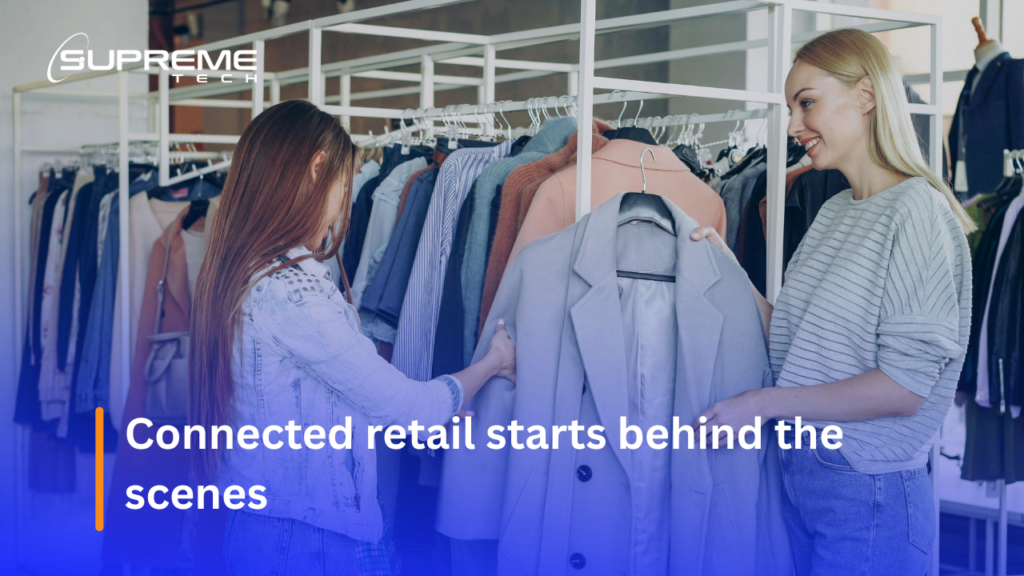
Connecting online and in-store experiences does not simply mean selling in both places. It means making sure the customer gets one smoother journey, even when they move between channels.
For fashion retailers, this usually starts with a few basic things working together. Product information should stay consistent across the website, app, and store. Inventory should be visible across channels, so customers and staff can see what is available and where. Promotions, loyalty benefits, and return rules should also follow the customer instead of changing from one channel to another.
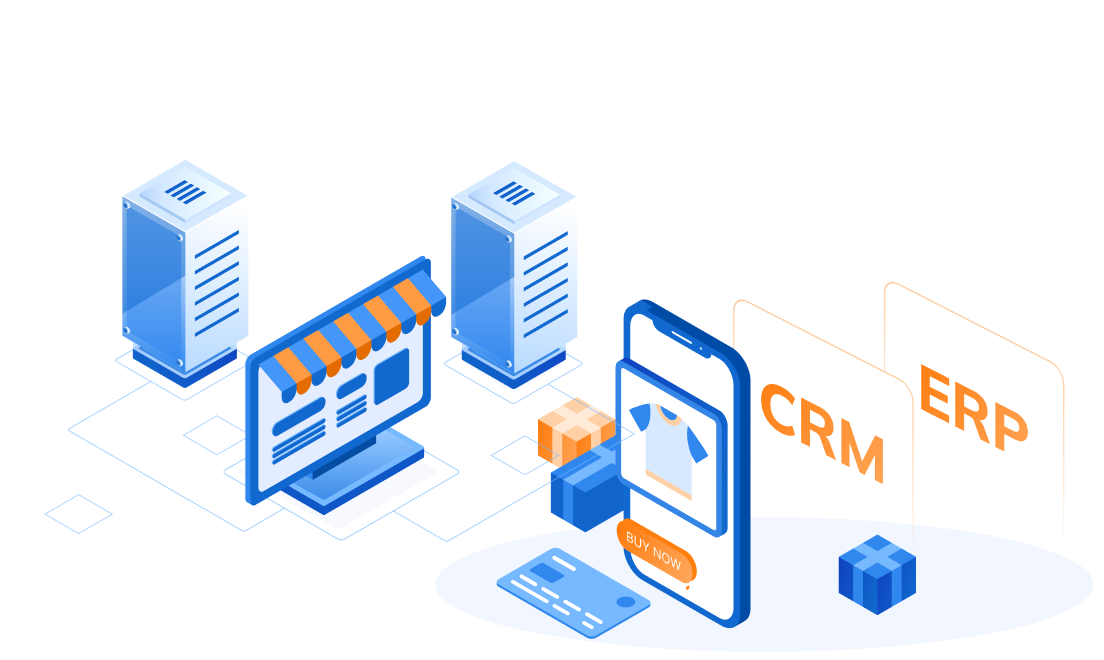
This is why the challenge is usually bigger than just improving the storefront or adding a new feature. It often depends on how well systems like ecommerce, POS, inventory, CRM, loyalty, and order management are connected behind the scenes. When those systems are aligned, the customer experience feels simpler. When they are not, the brand may look connected on the surface but still feel fragmented in real use.
In simple terms, connecting online and in-store experiences means building one retail journey across multiple touchpoints. The customer may move between channels, but the brand experience should still feel joined up, reliable, and easy to use.
How Fashion Retailers Can Connect Online and In-Store Experiences
Fashion retailers can connect online and in-store experiences by fixing the systems behind the customer journey, not just the customer-facing design. In practice, that usually means connecting inventory, customer data, order flows, store tools, and promotions so the brand works more like one retail business instead of separate channels.
Connect inventory across ecommerce and stores
Customers want to know whether an item is available in their size, color, and preferred location before they decide to buy. That means online and store inventory cannot stay separate.
What to do:
- sync stock visibility across ecommerce and stores
- let customers check nearby availability
- support fulfillment options like pickup or ship-from-store
This is not just theory. Shopify’s BOPIS guidance shows how buy online, pick up in store depends on connected inventory and store operations. BigCommerce also notes that omnichannel inventory management needs automated technology because manual coordination does not scale.
Build one customer view across channels
A shopper may browse online, buy in-store, return through another channel, and expect the brand to remember them throughout. If ecommerce, POS, CRM, and loyalty data stay disconnected, that experience breaks.
What to do:
- unify customer profiles across online and store touchpoints
- connect loyalty, purchase history, and service history
- make that information available to both digital and store teams
Some leading fashion and retail brands have already invested in this type of connected customer view to support more personalized experiences across digital and physical touchpoints. That shows the goal is not just data collection. It is better continuity across the whole journey.
Make fulfillment and returns work across channels
Fashion customers often move between channels before and after purchase. They may buy online, pick up in-store, return to a store, or expect exchanges to be handled smoothly regardless of where the order started.
What to do:
- connect order management with store operations
- allow flexible pickup, return, and exchange flows
- make order status visible across teams
This is especially important in fashion because returns are a normal part of the shopping process. If return and fulfillment systems are not connected, the brand creates friction after the sale, not just before it.
Give store teams the same visibility as digital teams
Stores cannot deliver a connected experience if staff are working with less information than the website. Store teams need access to stock status, customer context, order history, and fulfillment options.
What to do:
- equip staff with shared order and inventory visibility
- make loyalty and customer history accessible in-store
- support assisted selling with better data
This helps stores become a stronger part of the full customer journey instead of operating as a separate channel.
Keep promotions and pricing logic consistent
A connected retail experience breaks quickly when prices, offers, or loyalty rewards behave differently across channels without a clear reason.
What to do:
- use shared promotion logic where possible
- align loyalty rules across online and store channels
- reduce channel-by-channel exceptions that confuse customers
This is less about making every offer identical and more about making the retail logic feel clear and reliable.
Treat this as an integration project, not just a customer experience project
Many brands talk about seamless experiences, but the real work usually sits in the systems underneath. If ecommerce, POS, CRM, inventory, and order management are not connected well, the brand may improve the surface experience without fixing the real friction.
What to do:
- prioritize system integration before adding too many new frontend features
- identify where the biggest operational disconnects are
- improve the retail operating model, not only the customer interface
This is often where the biggest difference appears. Strong omnichannel fashion retail is usually built on better integration, not just better design.
Read related articles about Fashion retailers:
- Seamless Retail Bliss: Online-to-Offline Retail with Reserve Online, Pay In-Store
- Best Practices for Loyalty App Software from a Technical Viewpoint
What Decision-Makers Should Evaluate Before Starting
Before trying to connect online and in-store experiences, fashion retailers need to look beyond the customer-facing idea and evaluate the business foundation underneath it. In many cases, the challenge is not whether the brand wants a smoother omnichannel journey. The challenge is whether the current systems, teams, and operating model are ready to support it in a consistent way.
The first thing to evaluate is where the biggest disconnect actually sits today. For some retailers, the biggest issue is inventory visibility. For others, it is fragmented customer data, weak return workflows, or store teams lacking access to the same information as ecommerce teams. Starting with the clearest pain point helps the business focus on what needs to be fixed first instead of trying to improve everything at once.
The second point is how connected the core retail systems already are. Ecommerce, POS, CRM, inventory, loyalty, and order management do not need to be perfect before improvement starts, but decision-makers should understand where the main system gaps are. If those core systems are weakly connected, customer experience improvements on the surface will be harder to scale and maintain over time.
The third area is how much of the problem is integration and how much is modernization. Many fashion retailers are not working on a clean digital foundation. They are often dealing with older store systems, manual processes, separate data flows, or workarounds built over time. In those cases, the project is not only about connecting channels. It is also about reducing the structural complexity that keeps channels apart.
Another important point is operational readiness. A retailer may want services like store pickup, cross-channel returns, or more personalized in-store service, but these only work well if teams can support them day to day. That means leadership should evaluate store process changes, training needs, ownership across teams, and how much operational change the business can handle in each phase.
Finally, decision-makers should assess the delivery model itself. Omnichannel fashion retail projects usually involve multiple teams, multiple systems, and a mix of business and technical priorities. If the delivery approach is unclear, even a well-designed strategy can slow down during execution. A strong approach should make room for phased rollout, clear priorities, and long-term maintainability rather than pushing too much change at once.
Why SupremeTech Can Support This Well
This kind of omnichannel retail challenge is not only about adding new customer-facing features. It usually requires stronger system integration, cleaner data flow, and a more scalable retail operating foundation behind the scenes. That is where SupremeTech can add value.
SupremeTech supports businesses through retail platform integration, system modernization, custom digital product development, and offshore development support for teams that need structured execution across complex retail environments. For fashion retailers, these capabilities are especially relevant because connecting online and in-store experiences often depends on how well ecommerce, POS, inventory, CRM, loyalty, and order management systems work together over time.
Conclusion
Connecting online and in-store experiences in fashion retail is not just about adding more channels. It is about making the whole retail journey feel more consistent for the customer and more manageable for the business. For fashion retailers, this matters even more because the customer journey is rarely linear. Shoppers move between inspiration, store visits, online browsing, purchase, and returns with high expectations for convenience and consistency. When the systems underneath those moments stay disconnected, the brand experience starts to break in small but costly ways. Research on fashion, returns, and omnichannel delivery also shows that these gaps affect not only customer experience, but operational efficiency and profitability. Contact SupremeTech for more consulting information in this matter!
FAQs Section
Fashion retailers can connect online and in-store experiences by aligning inventory, customer data, fulfillment, promotions, and store systems so customers move more smoothly between channels.
It matters more in fashion because customers often browse online, visit stores to try items, compare sizes and colors, and expect loyalty, returns, and promotions to work consistently across the journey.
One of the biggest challenges is fragmentation across ecommerce, POS, inventory, CRM, loyalty, and order systems. Even when each channel works on its own, the overall journey can still feel disconnected.
Returns and exchanges are a major part of fashion retail because of fit, size, and customer preference. If these workflows are not connected across channels, they create friction after the sale and raise operational costs.
They should evaluate where the biggest disconnect sits today, how well core systems are connected, whether modernization is needed, how ready operations are for change, and whether the delivery model can support long-term scalability.
SupremeTech can support this through retail platform integration, system modernization, custom digital product development, and offshore development support for complex retail environments.